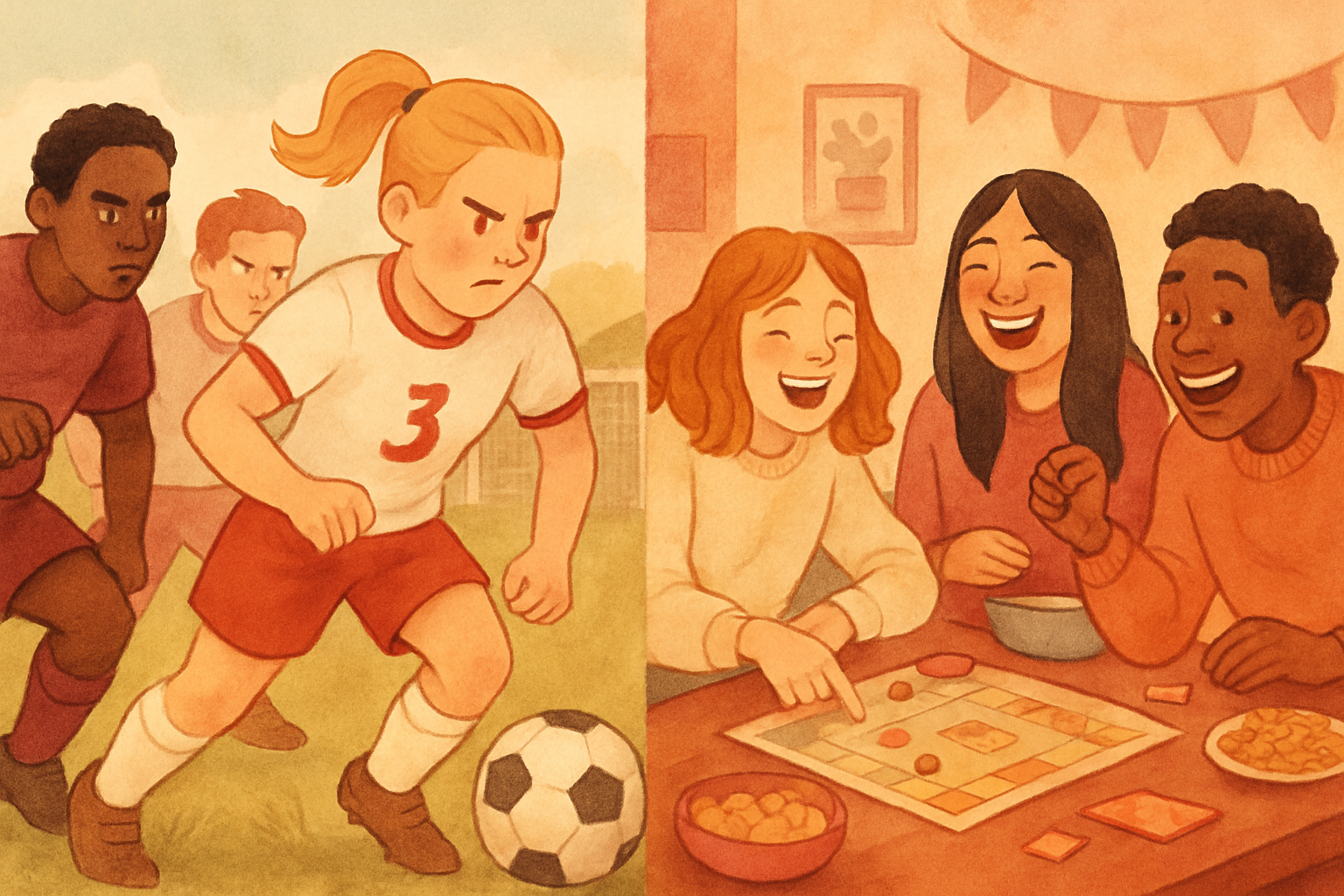
The way you play games together reveals everything about your relationship — from how you handle conflict to how you share power.
Picture this: You're locked in an intense game of trivia with your partner. The score is tied, and everything comes down to one final question about obscure NBA statistics. Do you feel that familiar rush of competitive fire, determined to claim victory? Or do you find yourself quietly hoping they get it right because their happiness matters more than winning?
The way couples play games together isn't just about entertainment — it's a window into the deeper dynamics of their relationship. Whether you're the type who celebrates every victory or the kind who'd rather work together toward a common goal, your game style reveals patterns that show up everywhere from decision-making to conflict resolution.
But here's what gets interesting: there's no "right" way to play together. The magic happens when you understand what your preferred style says about you, what your partner's style says about them, and how these preferences create either harmony or friction in your relationship.
What Does It Mean When Competition Brings You Together?
Competitive couples often get a bad rap, but healthy competition can actually strengthen relationships in surprising ways. When both partners embrace the challenge and treat wins and losses with equal grace, competition becomes a form of intimate play that builds mutual respect and keeps things exciting.
Research in relationship psychology shows that couples who engage in novel, arousing activities together — and yes, a heated game night definitely qualifies — experience increased relationship satisfaction. The key word here is "together." Healthy competitive couples aren't trying to dominate each other; they're creating shared experiences that happen to involve keeping score.
Take couples who bond over sports betting or prediction games. When the Cleveland Cavaliers face off against the Detroit Pistons tonight with a 4.5-point spread favoring Cleveland, competitive couples might find themselves on opposite sides of the bet — and loving every minute of the friendly rivalry. The Lakers might be 8.5-point underdogs against Oklahoma City Thunder, but that just makes the potential upset even more thrilling to argue about.
The beautiful thing about healthy competitive couples is that the competition enhances intimacy rather than threatening it. They've learned to separate the game from the relationship, celebrating each other's victories almost as much as their own. These couples often report feeling energized by their games together, like they're seeing new sides of each other that keep the relationship fresh and engaging.
But there's a shadow side to competitive relationships that's worth examining honestly.
When Competition Becomes Control: Red Flags to Watch For
Not all competitive dynamics are created equal. When competition shifts from playful challenge to a need for dominance, it reveals deeper issues about power and control that extend far beyond game night.
The clearest red flag is when one partner consistently needs to win at everything. This isn't about being good at games — it's about being unable to tolerate their partner having something they don't. These relationships often feature patterns where the "winner" dismisses their partner's victories ("you got lucky") while magnifying their own successes.
Another warning sign is when competition becomes personal. Healthy competitive couples can lose a game and laugh it off, maybe even congratulate their partner. Unhealthy competitive dynamics involve sulking, blame, or using game outcomes as ammunition in later arguments. If your partner brings up that time you beat them at Scrabble during an unrelated discussion about vacation planning, you're dealing with someone who can't separate play from power.
The "sore loser" test reveals crucial information about emotional regulation and conflict resolution. How someone handles losing a low-stakes game often predicts how they'll handle disagreements about high-stakes life decisions. A partner who can't gracefully accept losing a trivia game might struggle with compromise when it comes to choosing where to live or how to spend money.
Perhaps most concerning is when competitive partners use games to prove points about intelligence, worth, or capability. Games become weapons rather than connection tools, with victories serving as evidence of superiority rather than sources of shared enjoyment.
The Cooperative Couple: Building Teams or Avoiding Conflict?
On the flip side, couples who prefer cooperative games often pride themselves on being "team players" who work together rather than against each other. There's something beautiful about partners who light up when solving puzzles together or celebrating shared victories in collaborative challenges.
Cooperative play can build genuine teamwork skills that translate into real-life situations. Couples who excel at working together in games often report better communication, shared problem-solving abilities, and a strong sense of being "on the same team" when life gets challenging. They've practiced listening to each other's ideas, building on each other's strengths, and celebrating shared successes.
These couples often gravitate toward games that require coordination and communication — activities where success depends on understanding each other's thinking patterns and working in sync. There's research suggesting that couples who engage in cooperative activities show increased levels of oxytocin, the hormone associated with bonding and trust.
But cooperative preferences aren't always what they seem on the surface. Sometimes, what looks like healthy teamwork is actually conflict avoidance in disguise.
When Cooperation Masks Deeper Issues
The shadow side of cooperative couples emerges when the preference for "working together" becomes an inability to handle any form of disagreement. These couples might choose cooperative games not because they enjoy collaboration, but because competition feels too threatening to the relationship.
Some cooperative couples have never learned how to disagree constructively. They've created a dynamic where harmony is prioritized over authenticity, leading to relationships that look peaceful on the surface but lack the energy that comes from healthy conflict and resolution. They might avoid competitive games not because they don't enjoy them, but because they're afraid of what might happen if someone wins and someone loses.
This can create its own problems. Relationships need some friction to grow — not destructive conflict, but the kind of healthy tension that comes from two individuals maintaining their separate identities while choosing to be together. Couples who can't handle the mild stress of competitive play might struggle with bigger disagreements about values, goals, or life direction.
There's also the risk of losing individual identity in the pursuit of togetherness. When cooperation becomes the only acceptable way to interact, partners might suppress their competitive instincts or personal desires to maintain the peace. Over time, this can lead to resentment or a feeling that they can't be fully themselves in the relationship.
When Opposites Attract: Mixed-Style Couples
Perhaps the most interesting dynamics emerge when competitive and cooperative partners find each other. These mixed-style relationships often face unique challenges but also unique opportunities for growth and balance.
The competitive partner might initially feel frustrated by what they perceive as their partner's lack of drive or unwillingness to engage fully. Meanwhile, the cooperative partner might feel overwhelmed or attacked by their partner's intensity. Early in the relationship, game nights might end in confusion or hurt feelings as each person expects the other to share their preferred style.
But mixed-style couples who learn to navigate these differences often develop the strongest relationships. They learn to appreciate what each style brings to the table — the competitive partner's energy and drive balanced by the cooperative partner's diplomacy and teamwork skills.
Successful mixed-style couples often develop a repertoire of different types of games and activities. They might play competitive games when the cooperative partner is feeling confident and energetic, and cooperative games when the competitive partner wants to focus on connection rather than challenge. The key is reading each other's moods and needs rather than defaulting to one style all the time.
What Your Play Style Reveals About Conflict Resolution
The way you approach games together often mirrors how you handle real-life disagreements. Competitive couples who can play hard and then immediately return to affection and support often handle conflicts the same way — they can argue intensely about something they care about and then move forward without lingering resentment.
Cooperative couples might excel at finding win-win solutions to problems, approaching conflicts with a shared sense of "us against the problem" rather than "me against you." However, they might struggle when compromise isn't possible and someone has to make a difficult decision.
Mixed-style couples often develop the most sophisticated conflict resolution skills because they've had to learn how to bridge different approaches to competition and cooperation. They understand when to push for what they want and when to prioritize harmony.
Your game style also reveals patterns around emotional regulation, communication under pressure, and how you handle power dynamics. These insights can be incredibly valuable for understanding your relationship patterns and areas for growth.
The Science of Play in Adult Relationships
Research consistently shows that couples who play together stay together — but the type of play matters. Studies indicate that couples benefit most from activities that are novel, challenging, and arousing (in the physiological sense of increased heart rate and engagement, not necessarily sexual arousal).
Both competitive and cooperative games can meet these criteria, but they activate different relationship systems. Competitive play tends to increase individual arousal and can enhance attraction through what researchers call "misattribution of arousal" — the excitement from the game gets partially attributed to feelings about your partner.
Cooperative play activates attachment and bonding systems, increasing feelings of trust and teamwork. Both have their place in healthy relationships, which is why the most satisfied couples often engage in both types of play.
The key is understanding your natural preferences and learning to stretch beyond them occasionally. Competitive couples benefit from cooperative activities that remind them they're on the same team, while cooperative couples can grow from competitive activities that help them practice healthy conflict and individual expression.
Finding Your Balance: Questions to Consider
Understanding your play style starts with honest self-reflection. Do you feel energized by competition or drained by it? When you win, is your first instinct to celebrate your victory or to make sure your partner isn't feeling bad? When you lose, do you immediately want a rematch or do you need time to process the disappointment?
Pay attention to your partner's responses too. Do they seem to come alive during competitive games or do they withdraw? Do they celebrate your victories or do wins create distance between you? Are they more engaged during cooperative activities or do they seem bored without individual challenge?
Consider how your play styles show up in other areas of your relationship. If you're competitive in games, are you also competitive about career achievements, social status, or being "right" in discussions? If you prefer cooperation in games, do you also avoid conflict in other areas where some healthy disagreement might be beneficial?
The goal isn't to change your fundamental preferences but to expand your repertoire and understand how your styles complement or clash with your partner's approach.
Why Variety Matters: The Case for Mixed Experiences
The healthiest couples aren't necessarily those who share identical play styles, but those who can appreciate and engage with different types of experiences together. This flexibility mirrors the kind of adaptability that long-term relationships require as circumstances change and grow.
Sometimes you need the energy and excitement that comes from competitive play — the rush of trying to predict whether the Minnesota Timberwolves will cover the 5.5-point spread against San Antonio, or the satisfaction of finally beating your partner at their best game. Other times, you need the bonding and connection that comes from working together toward a shared goal.
The couples who thrive are those who can read the moment and choose the right type of play for what their relationship needs. Feeling disconnected? Try a cooperative challenge that requires communication and teamwork. Feeling stuck in routine? Bring out something competitive that creates energy and novelty.
This is where tools like Pairloom become particularly valuable. Rather than being locked into one style of interaction, couples can explore both competitive elements — like trivia challenges and prediction games — and cooperative experiences like Sketch Duet or working through Pressure Points together. The variety allows couples to discover new aspects of their dynamic and practice different ways of connecting.
Stop wondering. Start playing.
Pairloom turns the conversations that matter into games you'll actually enjoy. Invite your partner and discover how you really connect — in minutes, not months.
Stop wondering. Start playing.
Pairloom turns the conversations that matter into games you'll actually enjoy. Invite your partner and discover how you really connect — in minutes, not months.