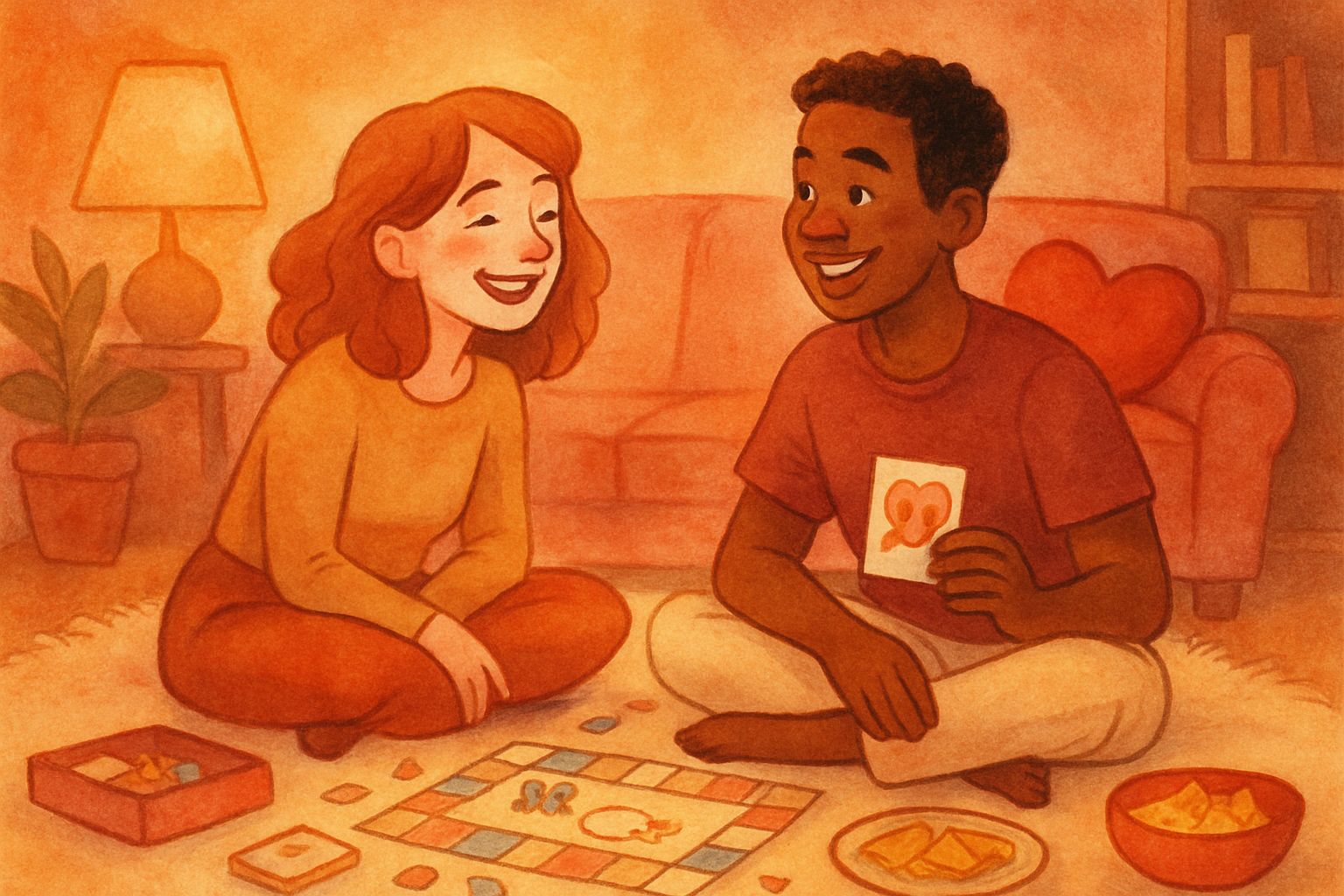
There's a version of game night that looks like this: two people laughing over a board game, a candle burning low, nobody checking their phone. And then there's the version most of us actually have — someone picks a game, the other person is mildly interested, and you're both in bed by 9:30 wondering why that felt hollow.
The difference usually isn't the game. It's whether the game gave you anything real to talk about.
The best couples games to play together aren't just entertainment. They're structured invitations to be honest, curious, and a little bit vulnerable — without it feeling like a therapy session. And honestly? That structure matters more than people realize.
Why Games Work When Conversations Don't
Most couples who want to connect more don't actually lack desire — they lack a format. After a long week, "let's have a deep conversation" can feel like homework. But "let's play a game" lowers the stakes just enough to let your guard down.
Research on what makes couples last consistently points to something called "self-disclosure" — the gradual, mutual process of sharing more of yourself with another person over time. The problem is that most long-term couples stop actively doing this. Life gets routine. You assume you already know each other.
Games disrupt that assumption. The right question, asked in the right context, can surface something you've never said out loud — even to yourself.
That's not magic. That's just good design.
What Actually Counts as a "Revealing" Game?
Not all games are created equal when it comes to getting to know your partner at a deeper level. Here's a quick breakdown of what separates the games that produce real insight from the ones that just kill time:
Games that reveal something:
- Ask questions that require you to reflect before answering
- Create asymmetry (one person answers, the other reacts — and that reaction tells you something too)
- Surface preferences, fears, values, or memories you haven't shared
- Have stakes that feel low but conversations that feel high
Games that mostly don't:
- Pure trivia (unless it's about each other)
- Abstract strategy games with no personal content
- Anything where winning is the point and conversation is incidental
The sweet spot is games that feel playful but land somewhere meaningful. Think less Scrabble, more "I never knew you felt that way."
The Classic Starter: 36 Questions (and Why It Still Works)
You've probably heard of the Arthur Aron "36 Questions" study — a series of increasingly personal questions designed to accelerate closeness between strangers. What's interesting is how well it works for couples who've been together for years.
The questions move through three levels: light and easy, more personal, and then genuinely vulnerable. The structure matters. Starting with "Would you like to be famous?" is very different from opening with "What do you fear most about our relationship?" The gradual escalation is the point.
Try it on a cozy night in. Read a question aloud. Both of you answer. Don't rush — the pauses are part of it.
If you want a version built for couples specifically (and for different relationship stages), Pairloom's question packs take this same tiered approach, with prompts designed around vulnerability in relationships, attachment styles in dating, and what you actually want your future to look like — together.
"I Never Knew That About You" — A Game You Can Play Tonight
This one requires nothing but honesty and a willingness to be surprised. Here's how it works:
One person says something true about themselves that they assume their partner already knows. The other person either confirms they knew it, or — and this is where it gets interesting — admits they didn't.
Couples who play this often discover that they've been assuming far more than they've actually shared. You might say "I've always wanted to live near the ocean" expecting a nod, and instead get a genuinely curious "Wait, really? I thought you loved city life." That's not a red flag. That's a doorway.
The game works because it flips the usual script: instead of discovering new things, you're checking the accuracy of what you think you already know. The gaps are where the conversation lives.
How Truth-or-Dare Becomes Something Better for Couples
Hear me out. Truth or Dare has a bad reputation because the defaults are usually either embarrassing or juvenile. But the format itself — choose your mode of vulnerability — is actually quite smart.
When you redesign it for couples, it becomes something different:
Truths become about feelings, history, and hopes rather than secrets or gossip.
- "What's something you want more of in our relationship right now?"
- "What's a moment when you felt really proud of us as a team?"
- "What's a fear you haven't told me about yet?"
Dares become about acts of tenderness or humor rather than shock value.
- "Tell me one thing you genuinely admire about me — without being sarcastic."
- "Show me how you'd describe our relationship using only hand gestures."
- "Read me your favorite text you've ever sent or received from me."
The key is that both options feel equally safe. If "truth" feels too exposed, "dare" should feel like a side door into the same room.
The Power of "Would You Rather" (Done Right)
Standard "Would You Rather" is fine. Couples-edition "Would You Rather" — where the choices are actually calibrated to surface values and priorities — is genuinely useful.
The best questions to ask your partner in this format aren't about preferences between silly hypotheticals. They're about real trade-offs that reveal how someone thinks:
- "Would you rather have more financial security or more time freedom?"
- "Would you rather we spent every weekend together or had more independent time?"
- "Would you rather fight openly and resolve things quickly, or avoid conflict and keep the peace?"
That last one? That's basically a compatibility test wrapped in a game. Couples who answer differently aren't automatically incompatible — but noticing the difference and talking about it is exactly the kind of healthy conflict in relationships that research says separates thriving couples from ones who slowly drift.
Compatibility Games: More Than a Quiz
The word "compatibility" gets thrown around a lot — usually in the context of compatibility tests for couples that feel like horoscopes: vague enough to mean anything, specific enough to feel clever. But real compatibility isn't about matching personality types. It's about how you handle the places where you don't match.
A good couples game surfaces those places gently. Some formats that work:
Ranking games: Each person privately ranks a list of values (adventure, stability, creativity, family, independence, etc.) by importance. Then you compare. Where your top-three overlap is where you're naturally aligned. Where they diverge is where you need to talk.
Finish-the-sentence games: "In five years, I hope we're..." — both people write an answer before sharing. The overlap and divergence are equally informative.
Scenario games: "If we won enough money to quit our jobs tomorrow, what would we each do?" Not because it's likely, but because the answers reveal a lot about what people actually want from life — vs. what they're currently doing out of obligation or habit.
These are the kinds of games built into Pairloom's couples experience. They're not about finding out if you're "meant to be" — they're about how to communicate better in a relationship by making the invisible visible, one prompt at a time.
What Happens When the Game Surfaces Something Hard?
This is the part nobody talks about in listicles about "fun couples games." Sometimes a prompt hits something real. Someone says more than they planned to. An answer surprises you — in a way that doesn't feel good.
That's not the game failing. That's the game doing exactly what it's supposed to.
The question is: do you know how to argue without fighting when that happens? Do you have enough trust to stay curious instead of defensive?
A few things help:
Pause before reacting. If your partner's answer surprises or bothers you, the game format gives you a natural moment to breathe before responding.
Use "I" language. "I didn't know you felt that way" lands completely differently than "You never told me that."
Stay in question mode. The point of these games isn't to reach conclusions — it's to ask more questions. "Tell me more about that" is almost always the right move.
Trust builds over time. If a session uncovers something tender, it doesn't have to be resolved tonight. You're building a relationship, not solving a puzzle.
The couples who get the most out of games like these are usually the ones who've already done some work on understanding their own attachment styles in dating — and who can recognize when they're being triggered vs. when they're genuinely learning something new about their person.
For more on how attachment patterns show up in everyday moments, check out our post on attachment styles and what they mean for your relationship.
Date Night at Home, Upgraded
If you're looking for date night ideas at home that go beyond "pick a movie and hope for the best," games are genuinely one of the highest-ROI options available. Low cost, low logistics, high potential for actual connection.
A few formats that work well for a proper game-based date night:
-
The Appreciation Round: Start with five minutes where each person shares one thing they've noticed and appreciated about the other this week. Not grand gestures — small observations. Sets the tone for openness.
-
The Question Stack: Use a card game or a curated question list (Pairloom's prompts work really well here). Take turns. No phones. Commit to actually answering, not deflecting.
-
The Reveal Round: End with one honest thing each — something you want more of, something you're grateful for, something you've been sitting with. It doesn't have to be heavy. It just has to be real.
The whole thing can take 45 minutes or two hours, depending on where the conversation goes. And if you're in a long-distance relationship, almost all of this works over video — it might even work better, because the format removes some of the ambient distraction.
For more on making connection work across distance, our piece on long-distance relationship tips has some practical options that go beyond "watch the same movie at the same time."
Signs the Game Is Working
You'll know a couples game is doing its job when:
- One of you says "I've never thought about it that way before"
- The conversation keeps going after the game technically ends
- You learn something that makes you more curious, not more anxious
- Both people feel equally seen — not just interviewed
- You go to sleep feeling closer than you did at dinner
These are signs you are compatible — not because you answered everything the same way, but because you stayed curious about the differences. That's the whole thing. That's what makes couples last.
Stop wondering. Start playing.
Pairloom turns the conversations that matter into games you'll actually enjoy. Invite your partner and discover how you really connect — in minutes, not months.
Stop wondering. Start playing.
Pairloom turns the conversations that matter into games you'll actually enjoy. Invite your partner and discover how you really connect — in minutes, not months.