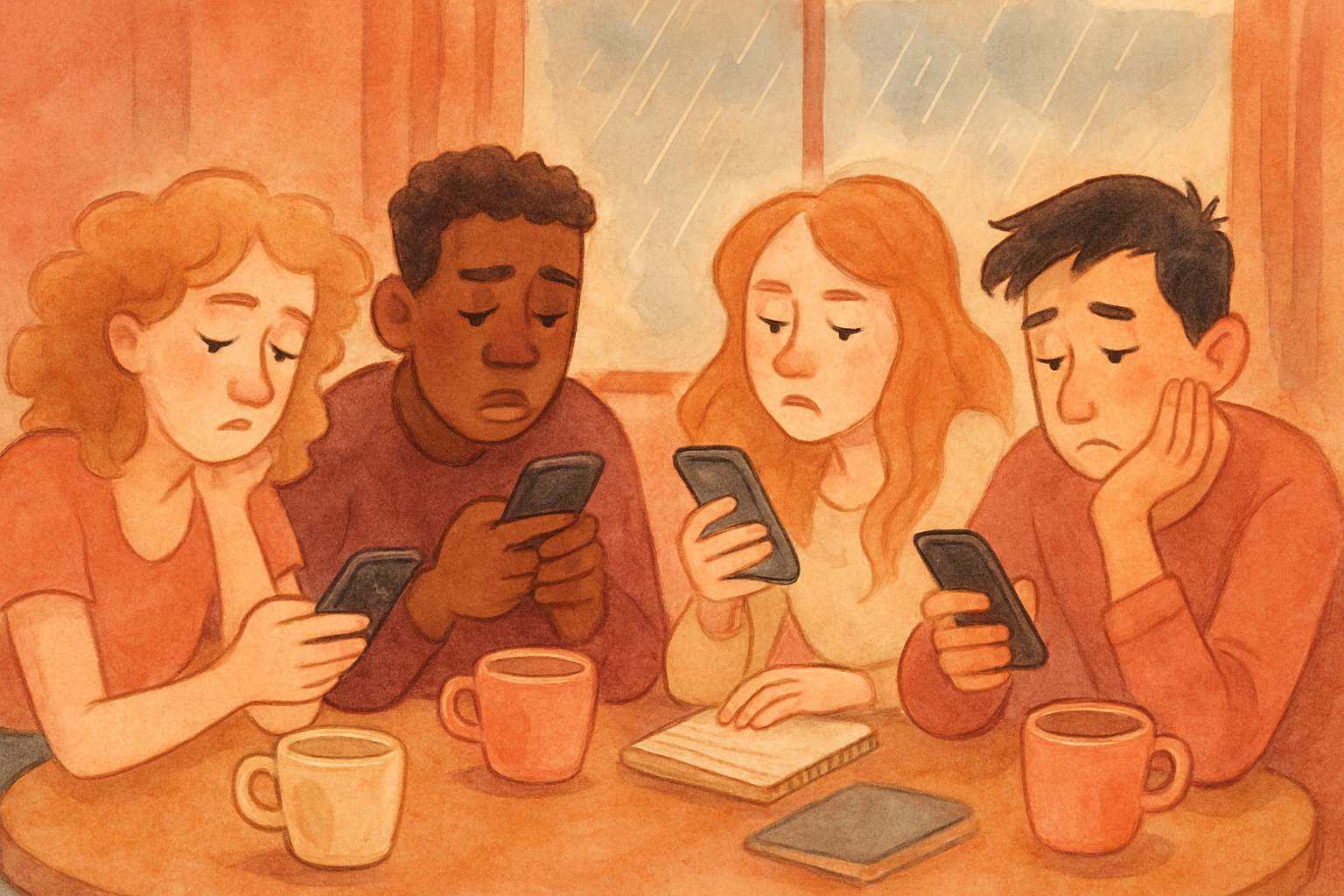
That sinking feeling when you open your dating app for the hundredth time this week, thumb poised over the screen, only to feel... nothing. The faces blur together. The conversations feel scripted. The whole process has become as appealing as a root canal. If this sounds familiar, you're not alone — and you're definitely not broken.
Dating app fatigue is more than just being "picky" or "difficult." It's a genuine psychological response to a system that's fundamentally at odds with how we're wired to form connections. The good news? There are real, research-backed ways to break free from the burnout.
Why Does Dating App Fatigue Feel So Universal?
The numbers tell the story. According to Pew Research, 46% of dating app users find the experience frustrating. Nearly half. That's not a few disgruntled singles — that's a systemic issue with how these platforms operate.
The problem isn't that we're ungrateful for technology that connects us with potential partners. It's that our brains weren't designed for the peculiar cocktail of endless choice, instant judgment, and gamified romance that defines modern dating apps.
Think about it: when was the last time you had to make hundreds of split-second decisions about people based on five photos and a few sentences? When did you ever have to simultaneously manage conversations with strangers while constantly evaluating whether someone "better" might be just one swipe away?
The answer is never. This is a completely novel social situation, and our ancient brains are struggling to keep up.
The Psychology Behind the Swipe Fatigue
Choice Overload: When More Options Make Everything Worse
Psychologist Barry Schwartz identified this phenomenon in "The Paradox of Choice" — the counterintuitive reality that having too many options often leads to worse outcomes and decreased satisfaction. In dating apps, this manifests as what researchers call "choice overload paralysis."
When you're presented with seemingly endless potential matches, several things happen:
- Decision fatigue sets in faster. Your brain literally gets tired from making so many rapid evaluations.
- You become more likely to avoid making decisions altogether. Hence the endless scrolling without actually messaging anyone.
- Even when you do choose, you're less satisfied with your choice. There's always the nagging sense that someone "better" is just around the corner.
This isn't a character flaw — it's basic human psychology. Our brains evolved to handle small tribes, not infinite scroll feeds of potential mates.
Dopamine Habituation: The Diminishing Returns of the Swipe
Dating apps are masterfully designed to trigger dopamine releases — that little hit of satisfaction when you get a match or a message. But here's the catch: our brains adapt to repeated stimuli through a process called habituation.
The first few matches feel exciting. Match number 50? Not so much. You need increasingly more stimulation to achieve the same level of satisfaction. This is why many people find themselves swiping more frantically over time while enjoying it less and less.
The apps are literally training your brain to need constant novelty while simultaneously making that novelty feel less rewarding. It's a psychological hamster wheel.
Rejection Desensitization: When People Become Products
Perhaps most damaging is how dating apps condition us to treat potential partners — and ourselves — like products on a shelf. You have seconds to "sell" yourself through photos and a brief bio. Others have seconds to decide if you're worth their time.
This creates what psychologists call "rejection desensitization" — not just becoming numb to being rejected, but becoming numb to rejecting others. When swiping left becomes as automatic as scrolling past an ad, we lose something essentially human: the ability to see nuance, potential, and the full spectrum of what makes someone attractive beyond the superficial.
What Does Dating App Burnout Actually Look Like?
Dating app fatigue manifests differently for different people, but common signs include:
Emotional symptoms:
- Feeling cynical about dating and relationships
- Anxiety about opening dating apps
- Disappointment that feels disproportionate to the actual stakes
- A sense that all conversations feel the same
Behavioral symptoms:
- Endless swiping without messaging matches
- Starting conversations that fizzle out quickly
- Deleting and re-downloading apps repeatedly
- Avoiding dating altogether despite wanting a relationship
Physical symptoms:
- Thumb fatigue (yes, really)
- Eye strain from constant screen time
- Sleep disruption from late-night swiping sessions
If you're nodding along, know that these are normal responses to an abnormal dating environment.
Practical Strategies to Combat Dating Burnout
Set Strict Time Boundaries
The first step is treating dating apps like what they actually are: tools, not entertainment. Set specific times for checking apps — maybe 15 minutes after breakfast and 15 minutes before dinner. Use your phone's app limits to enforce these boundaries.
When your time is up, close the app. The matches will still be there tomorrow, but your mental energy won't regenerate if you're constantly depleting it.
Focus on One App at a Time
Dating app polygamy is exhausting. Pick one platform that aligns with what you're looking for and commit to it for at least a month. This reduces decision fatigue and allows you to actually get good at using that particular app's features and culture.
Shift From Screening to Exploring
Instead of looking for reasons to swipe left, try looking for reasons to be curious. What story does this person's photo combination tell? What questions do their prompts raise? This mindset shift can make the process feel more like genuine discovery and less like an assembly line.
Try Compatibility-First Approaches
Consider apps that prioritize compatibility over appearance, like eharmony or newer platforms that use personality assessments. While these might feel slower, they often lead to more meaningful connections with less burnout.
The Slow Dating Movement: An Antidote to Swipe Culture
A growing number of people are embracing "slow dating" — the intentional practice of taking time with each potential connection instead of constantly seeking the next one. This might mean:
- Limiting yourself to five new conversations at a time
- Spending at least a week texting before meeting in person
- Asking deeper questions earlier in the conversation
- Taking breaks between dates to process your feelings
The slow dating philosophy recognizes that meaningful connections take time to develop — something that gets lost in the instant-gratification culture of most dating apps.
Rethinking the Entire Approach
Maybe the problem isn't how we're using dating apps — maybe it's the fundamental premise of dating apps themselves. The standard model asks us to make judgments about compatibility before we've actually experienced what it's like to interact with someone. It's like trying to choose a dance partner based on their headshot.
What if there was a different way? What if instead of judging first and hoping for chemistry later, we could play together first and then decide if we want to explore something deeper?
This is where new approaches to digital connection are emerging — platforms that prioritize shared experiences over profile optimization, where you discover compatibility through interaction rather than assumption.
Why Traditional Dating Apps Keep Failing Us
The core issue with most dating apps is that they're built on a fundamentally flawed premise: that you can determine romantic compatibility by looking at someone's curated presentation of themselves. It's like trying to choose a movie based only on the poster.
Real attraction — the kind that leads to lasting relationships — emerges through interaction. It's about how someone makes you laugh, how they handle disagreement, what it feels like to solve problems together. None of these things can be captured in a dating profile.
When Taking a Break Isn't Enough
If you've tried the strategies above and still feel burned out, it might be time for a more fundamental shift in approach. Sometimes the answer isn't to use dating apps better — it's to use them differently, or not at all for a while.
Consider exploring ways to meet people that don't involve apps: hobby groups, volunteer work, classes, or social events in your community. The goal isn't necessarily to find dates, but to remember what it feels like to connect with people without the artificial constraints of a dating platform.
A Different Way Forward
The dating app landscape is starting to evolve beyond the swipe-and-hope model. New platforms are experimenting with shared activities, compatibility games, and experiences that let people discover chemistry naturally.
Instead of starting with judgment, these approaches begin with play. Instead of screening for deal-breakers, they create opportunities for genuine surprise. Instead of optimizing profiles, they facilitate real interactions.
This isn't about finding a "better" dating app — it's about finding an entirely different paradigm for digital connection. One where you get to be yourself from the beginning, where compatibility is discovered rather than claimed, where the process of getting to know someone is actually enjoyable.
The best part? When connection starts with shared experience rather than mutual evaluation, the pressure disappears. You're not performing for approval — you're simply being yourself and seeing who appreciates that authentic version of you.
Stop wondering. Start playing.
Pairloom turns the conversations that matter into games you'll actually enjoy. Invite your partner and discover how you really connect — in minutes, not months.
Stop wondering. Start playing.
Pairloom turns the conversations that matter into games you'll actually enjoy. Invite your partner and discover how you really connect — in minutes, not months.