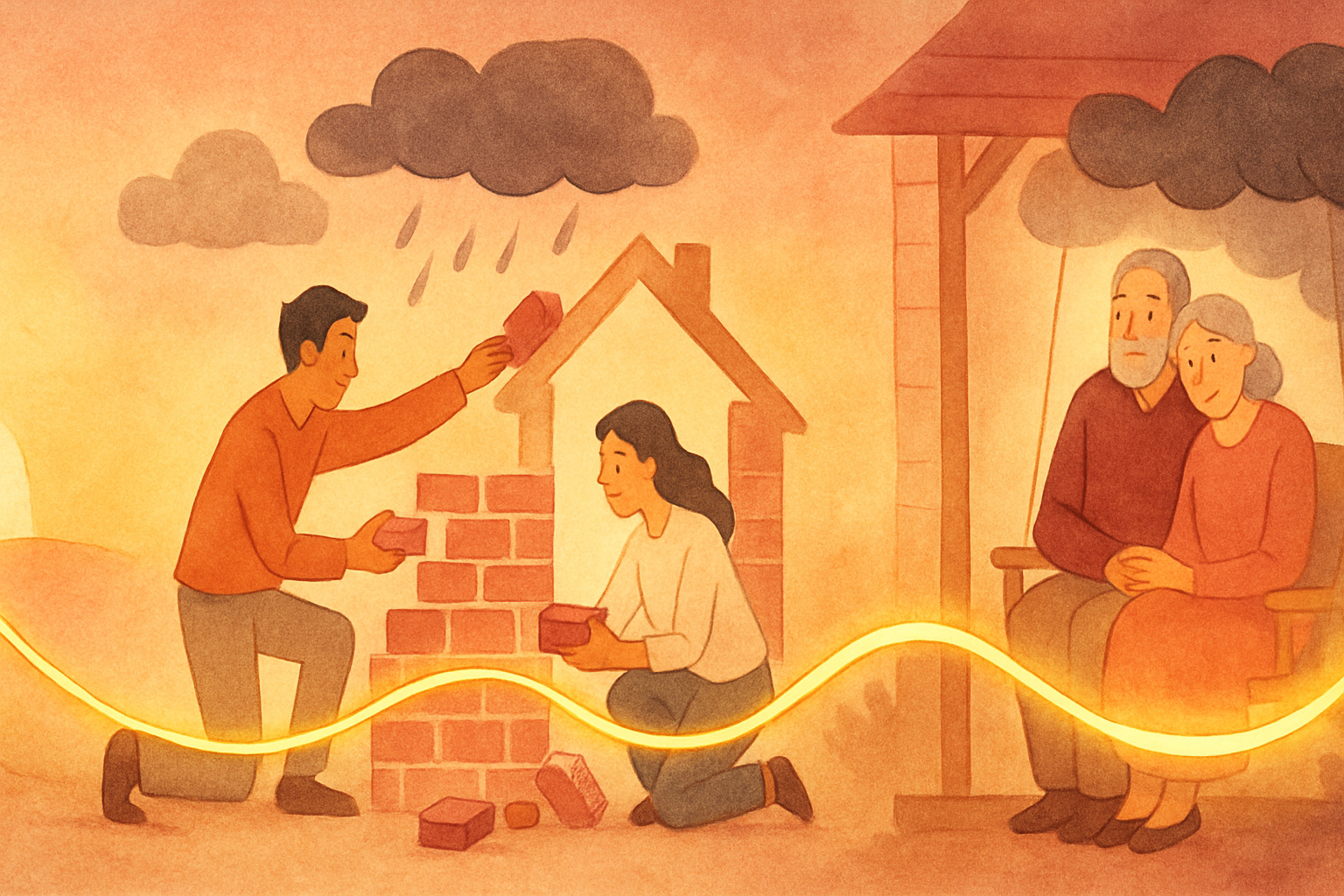
How Couples Who Last Are Different From Couples Who Don't
Picture this: you're at a party, watching two couples across the room. One pair seems to move in perfect sync—laughing at each other's jokes, touching briefly while passing, catching each other's eye with knowing smiles. The other couple stands slightly apart, one person checking their phone while the other talks to someone else, their interactions feeling more like polite roommates than romantic partners.
What makes the difference? Why do some relationships thrive for decades while others fizzle out after the initial spark fades?
Thanks to groundbreaking research spanning over 75 years—including Dr. John Gottman's famous "Love Lab" and Harvard's Grant Study on adult development—we now have scientific answers to what separates couples who last from those who don't. And spoiler alert: it's not about being perfectly compatible or never fighting.
What does the research actually say about relationship success?
The most comprehensive relationship research comes from two landmark studies that have followed couples and individuals for decades. Dr. John Gottman's research at the University of Washington has tracked over 3,000 couples since the 1970s, with some studies following pairs for up to 20 years. His "Love Lab" can predict divorce with over 90% accuracy just by observing couples interact for a few minutes.
Meanwhile, Harvard's Grant Study—now in its 84th year—has followed the same group of people since 1938, making it one of the longest-running studies on human development ever conducted. Originally led by George Vaillant and now by Dr. Robert Waldinger, this research has produced a startling finding: the quality of our relationships is the strongest predictor of life satisfaction and health, more than money, career success, or even genetics.
As Waldinger puts it: "Good relationships keep us happier and healthier. Period."
But what makes a relationship "good"? The answer might surprise you.
Why don't intelligence and income predict relationship success?
You might think that couples who are well-educated, financially stable, or intellectually matched would have the best shot at lasting love. The research says otherwise.
Harvard's Grant Study found that emotional intelligence—not IQ, not income level, not social status—was the strongest predictor of relationship satisfaction over time. Participants who learned to identify, understand, and manage emotions (both their own and their partner's) were significantly more likely to have thriving relationships decades later.
Dr. Vaillant discovered that many of the study's most academically and professionally successful participants struggled in relationships if they lacked emotional skills. Meanwhile, participants with average incomes and education but high emotional intelligence often reported the deepest relationship satisfaction.
This makes sense when you think about it. You don't need a PhD to notice when your partner has had a tough day, or to offer comfort during stressful times. You don't need a six-figure salary to say "I'm sorry" after an argument or to celebrate your partner's small wins. What you need is the ability to tune into emotional cues and respond with care.
What is the "magic ratio" that predicts relationship longevity?
One of Gottman's most famous discoveries is what he calls the "magic ratio": successful couples have at least five positive interactions for every negative one. This 5:1 ratio held true across thousands of couples, regardless of their communication style or personality types.
But here's what's crucial—this doesn't mean avoiding conflict. Gottman found that couples who last actually argue, sometimes quite intensely. The difference is in how they repair and reconnect.
Positive interactions include:
- Expressing genuine interest in your partner's day
- Physical affection (even brief touches)
- Humor and playfulness
- Expressions of appreciation
- Acts of support during stress
- Shared joy and celebration
Negative interactions that erode the ratio include:
- Criticism of character (not just behavior)
- Contempt and eye-rolling
- Defensiveness
- Stonewalling or shutting down
The couples who maintain that 5:1 ratio don't necessarily fight less—they just make sure to flood their relationship with enough positivity to outweigh the inevitable negative moments.
How do successful couples handle daily interactions differently?
Gottman discovered something remarkable: relationships aren't built on grand romantic gestures or big conversations. They're built on tiny moments throughout each day.
He calls these moments "bids"—small attempts to connect with your partner. A bid might be pointing out a beautiful sunset, sharing a funny meme, or simply saying "How was your meeting?" The crucial factor isn't the bid itself, but how partners respond.
Gottman identified three types of responses:
- Turning toward: Engaging with the bid ("Oh wow, look at those colors!")
- Turning away: Ignoring or missing the bid entirely
- Turning against: Rejecting the bid ("I'm busy, can't you see?")
Couples who stayed together turned toward their partner's bids 86% of the time. Couples who later divorced only turned toward 33% of the time. These micro-moments of connection or disconnection compound over time, creating either a foundation of emotional intimacy or a growing sense of loneliness.
Think about your own relationship: when your partner shares something they found interesting, do you look up from your phone? When they reach for your hand, do you squeeze back? These small responses shape your relationship's trajectory more than you might imagine.
What role does admiration play in lasting relationships?
Beyond the 5:1 ratio and turning toward bids, Gottman identified what he calls the "fondness and admiration system"—essentially, whether partners maintain genuine respect and affection for each other over time.
Couples who last actively cultivate fondness by:
- Remembering positive memories: They can tell the story of how they met with warmth and detail
- Highlighting partner strengths: They notice and acknowledge what their partner does well
- Expressing gratitude: They regularly thank each other for both big and small contributions
- Assuming positive intent: When conflicts arise, they give their partner the benefit of the doubt
Dr. Waldinger's research at Harvard supports this finding. Study participants who spoke about their spouses with genuine warmth and respect—even when acknowledging their flaws—had stronger relationships decades later. Those who focused primarily on their partner's shortcomings or spoke with subtle contempt were more likely to divorce or report relationship dissatisfaction.
The good news? Fondness and admiration can be rebuilt even after they've eroded. It starts with consciously noticing things you appreciate about your partner and expressing those observations out loud.
How do lasting couples create shared meaning together?
Harvard's Grant Study revealed another crucial factor: couples who last create shared meaning through rituals, goals, and narratives. This goes beyond just having things in common—it's about actively building a life together that feels purposeful to both partners.
Shared meaning can include:
- Weekly or daily rituals: Sunday morning coffee together, evening walks, or bedtime conversations
- Common goals: Planning trips, working on home projects, or supporting each other's individual aspirations
- Shared narratives: The stories you tell about your relationship, your family, and your future
- Traditions: How you celebrate holidays, birthdays, or personal milestones
Interestingly, the Harvard research found that couples didn't need to share all the same interests or values. What mattered was creating new traditions and meanings together, building something that felt uniquely theirs.
This shared meaning acts as a buffer during difficult times. When couples have rituals to return to and goals they're working toward together, temporary conflicts feel less threatening to the relationship's foundation.
Why is conflict resolution more important than avoiding fights?
Here's where many people get relationships wrong: they think successful couples don't fight. The research shows the opposite is true.
Gottman found that 69% of relationship problems are perpetual—meaning they never fully get resolved. Successful couples learn to manage these ongoing differences rather than solve them. The key is how they handle conflict when it arises.
Couples who last follow what Gottman calls "repair" patterns:
- They take breaks when emotions get too heated
- They use "I" statements instead of accusations
- They acknowledge their partner's feelings even when they disagree
- They find compromise or agree to disagree respectfully
- They reconnect after arguments with affection or humor
The Harvard Study supports this, showing that couples who learned to "fight fair"—addressing issues without attacking character or bringing up past grievances—maintained stronger relationships over decades.
Dr. Carol Dweck's research on growth mindset applies here too. Couples who view relationship challenges as opportunities to grow together, rather than evidence of incompatibility, are more likely to work through difficulties and emerge stronger.
What can we learn from couples married 50+ years?
The longest-running participants in Harvard's Grant Study—now in their 90s and 100s—offer unique insights into what sustains love over half a century or more.
These couples consistently report:
- Friendship as the foundation: They genuinely like spending time together
- Maintained curiosity: They continue learning new things about each other
- Shared growth: They've evolved together rather than growing apart
- Humor and playfulness: They can still make each other laugh
- Physical affection: They maintain appropriate touch and intimacy
- Mutual support: They've weathered life's challenges as a team
Perhaps most importantly, these long-term couples developed what researchers call "relationship resilience"—the ability to bounce back from setbacks stronger than before. They view their partnership as something worth protecting and investing in, even when times get tough.
How does emotional intelligence develop in relationships over time?
One fascinating finding from both Gottman's and Harvard's research is that emotional intelligence in relationships can be learned and improved. Couples who last often show increasing emotional skills over time, even if they didn't start with high levels.
Key emotional intelligence skills that successful couples develop include:
- Emotional awareness: Recognizing their own and their partner's emotional states
- Empathy: Understanding and validating their partner's emotional experience
- Emotional regulation: Managing strong emotions during conflicts
- Social skills: Navigating relationship challenges with grace and humor
The Harvard Study participants who showed the most relationship satisfaction over time were those who continued developing these emotional skills throughout their adult lives. It's never too late to become more emotionally intelligent in your relationship.
What daily habits distinguish successful long-term couples?
Looking across decades of research, certain daily practices emerge as common among couples who thrive:
Morning and evening rituals: Successful couples create predictable moments of connection, like sharing coffee before work or talking about their day before bed.
Regular appreciation: They make expressing gratitude a habit, not just something that happens during special occasions.
Protective boundaries: They prioritize their relationship by setting boundaries around work, technology, and other relationships.
Continued courtship: They maintain small romantic gestures and continue "dating" each other throughout their relationship.
Individual growth: Paradoxically, couples who last maintain their individual identities and continue growing as separate people.
How can you apply this research to strengthen your own relationship?
The beautiful thing about relationship science is that it gives us a roadmap for building stronger connections. Unlike personality traits or family history, the behaviors that predict relationship success can be learned and practiced.
Start small:
- Pay attention to your partner's bids for connection and practice turning toward them
- Notice and express appreciation for things your partner does
- Create simple daily or weekly rituals together
- Work on your own emotional awareness and regulation skills
- Focus on repair after conflicts rather than winning arguments
Remember, lasting relationships aren't built on perfection—they're built on consistent, caring responses to your partner over time. Every interaction is an opportunity to deposit positivity into your relationship's emotional bank account.
The couples who last understand that love isn't just a feeling—it's a practice. And like any skill worth developing, it gets stronger with intentional effort and attention.
Stop wondering. Start playing.
Pairloom turns the conversations that matter into games you'll actually enjoy. Our research-backed games help you practice the exact skills that predict relationship longevity—from emotional intelligence to conflict resolution to building shared meaning together. Invite your partner and discover how you really connect — in minutes, not months.
Stop wondering. Start playing.
Pairloom turns the conversations that matter into games you'll actually enjoy. Invite your partner and discover how you really connect — in minutes, not months.