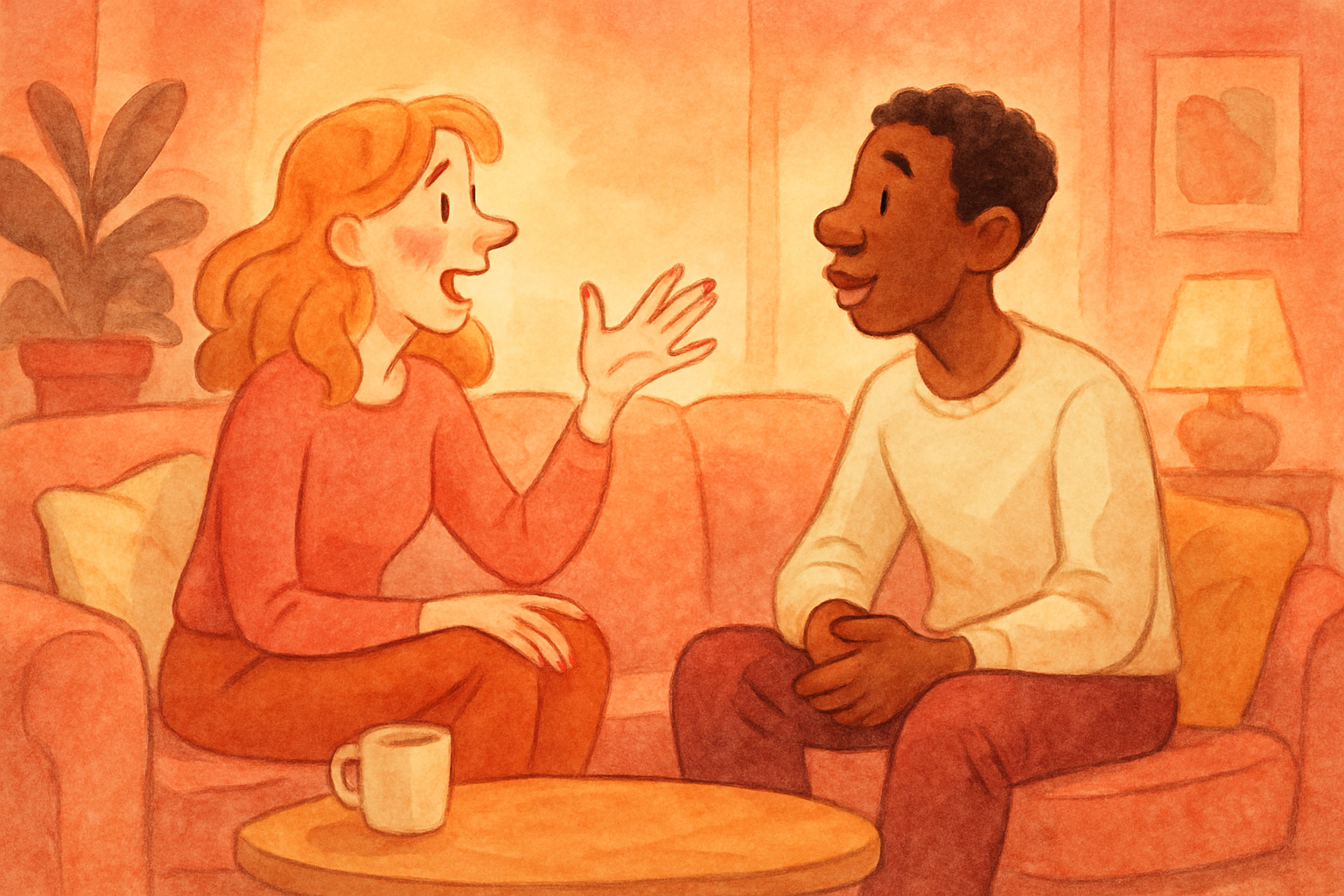
If you've ever felt like you and your partner are speaking completely different languages — even when you're both technically speaking English — you're not alone. Communication style differences are one of the most common friction points in relationships, and they show up early, stay late, and have a way of making small disagreements feel enormous.
The good news? Learning how to communicate better in a relationship isn't about becoming the same person. It's about building a shared language that honors who you both already are.
Let's dig into what's actually happening when communication breaks down, and what you can do about it — starting today.
Why Do Two People Who Love Each Other Struggle to Talk?
It seems counterintuitive, right? You care deeply about this person. You want things to work. So why does a simple conversation about weekend plans sometimes spiral into a two-hour standoff?
The answer often lies in the invisible architecture of how each person learned to communicate in the first place.
Our communication styles are shaped by a combination of our upbringing, our personality, and — backed by a growing body of research — our attachment styles. Psychologist John Bowlby's attachment theory, later expanded by researchers like Mary Ainsworth and applied to adult relationships by Cindy Hazan and Phillip Shaver, tells us that people broadly fall into secure, anxious, avoidant, or disorganized attachment patterns. These patterns don't just affect how we feel loved — they directly shape how we express ourselves and interpret conflict.
An anxiously attached person might need to talk right now, process out loud, and seek frequent reassurance. An avoidantly attached person might need space to think, retreat when things get heated, and view emotional intensity as overwhelming rather than intimate. Put those two people together — which happens constantly — and you get a pursuer-distancer dynamic that can feel like chasing someone who's running, or being chased when you just want to breathe.
Understanding attachment styles in dating and long-term partnerships isn't a cure-all, but it is a powerful frame. When you recognize that your partner's silence isn't dismissal, or that your partner's urgency isn't an attack, you can start responding to the actual person instead of the story you've built about them.
What Are the Main Communication Styles — and Where Do You Fall?
Researchers and relationship therapists generally identify four core communication styles:
1. Assertive — Direct, confident, and emotionally clear. This person says what they mean, listens actively, and tends to navigate conflict well. The gold standard, honestly.
2. Passive — Avoids confrontation, often doesn't express needs directly, may bottle things up until they boil over. This person often appears "easygoing" until they're suddenly not.
3. Aggressive — Expressive and direct, but in ways that can feel threatening or dismissive. The goal is often to "win" rather than to understand.
4. Passive-Aggressive — Expresses frustration indirectly: sarcasm, silent treatment, doing things halfway. Hard to address because it rarely comes out in the open.
Most of us aren't locked into one style permanently — we shift depending on stress, context, and who we're talking to. But we do have defaults, and those defaults tend to show up most clearly in conflict.
Here's the tricky part: none of these styles are purely chosen. They're habituated responses. Which means changing them takes awareness, practice, and — crucially — a partner who's willing to do the same work.
How Do You Actually Close the Gap?
Start With Curiosity, Not Conclusions
One of the most transformative shifts you can make is moving from assuming to asking. Instead of thinking "they don't care about my feelings because they went quiet," try "I noticed you got quiet — what's going on for you?"
This sounds simple. It is not always simple. It requires you to hold your own emotional reaction long enough to get genuinely curious about your partner's inner world. Researcher and relationship therapist Esther Perel often talks about the way couples stop being curious about each other once they think they "know" the other person. Curiosity is a form of intimacy — and it opens doors that assumptions close.
Some questions to ask your partner that can reopen dialogue when you're stuck:
- "What did you need from me in that moment that you didn't get?"
- "How would this conversation feel different if we were on the same team?"
- "What do you wish I understood about how you experience conflict?"
These aren't therapy questions — they're human questions. And they work.
Learn Each Other's "Processing Style"
Some people process emotions externally (talking it out is how they figure out how they feel). Others process internally (they need to think before they speak). Neither is wrong — but they can collide hard.
If you're an external processor and your partner is internal, you might feel like they're shutting you out when they go quiet. They might feel like you're pushing them before they have anything real to say. The fix isn't to force one style on both of you — it's to create structure around the difference.
That might look like: "I need about 20 minutes to gather my thoughts, then I really want to talk about this." Or: "Can we keep talking? I process by speaking — even if I'm not making sense yet."
Naming your process out loud is a kind of vulnerability in relationships that pays enormous dividends. It transforms what looks like a character flaw into useful information.
Understand the Difference Between Styles and Red Flags
This is an important distinction. Different communication styles are not the same as relationship red flags. Style differences are navigable. Red flags are patterns that signal something more serious.
A dealbreaker in a relationship — like a partner who uses communication to control, humiliate, or consistently dismiss your reality — is different from a partner who just gets defensive when they feel criticized. Both need attention, but they require very different responses.
Signs you are compatible enough to navigate style differences include: both people being willing to reflect on their own behavior, both people showing genuine interest in the other's experience, and both people being able to repair after conflict rather than letting things fester permanently.
How to Argue Without Making Things Worse
Healthy conflict in relationships isn't the absence of fighting. It's fighting in ways that bring you closer rather than further apart. The Gottman Institute's decades of research on couples identified four communication behaviors — contempt, criticism, defensiveness, and stonewalling — as the most damaging patterns in relationships. They call them the "Four Horsemen."
Contempt, in particular, is the strongest predictor of relationship decline. It's the eye-roll, the dismissive tone, the "I can't believe you're being like this." The antidote, according to their research, is building a culture of genuine appreciation and fondness — which sounds soft but is actually rigorous work.
Practical ways to argue without fighting:
Take breaks with a return time. Saying "I need to step away" without a return plan can feel like abandonment. "I need 30 minutes and then I'll be back" is a pause, not a shutdown.
Use "I" statements instead of "you" accusations. "I feel unheard when our conversations get cut short" lands very differently from "You never listen to me."
Name the pattern, not the person. "We keep ending up in this loop" puts you on the same side. "You always do this" makes your partner the problem.
Check in about what you each need right now. Sometimes one person wants to be heard, and the other is immediately in problem-solving mode. Asking "do you want support or solutions right now?" can short-circuit a lot of mutual frustration.
Does "Compatible" Mean Same Communication Style?
Not at all — and this is where relationship compatibility gets interesting.
Research doesn't suggest that the most compatible couples are those who communicate identically. It suggests that the most lasting couples are those who have developed systems for navigating their differences. What makes couples last isn't sameness — it's the combination of mutual respect, shared values, and a genuine commitment to understanding each other.
A compatibility test for couples isn't about finding a perfect match — it's about revealing the gaps that need bridging and the strengths you can build on. Knowing where you differ is actually more useful than knowing where you're the same, because differences are where the real relational work happens.
One of the most valuable things you can do — especially early in a relationship, during the talking stage dating phase, or when you're trying to understand if a situationship has real legs — is to have structured conversations about communication itself. Not "why do you always do that," but "how do we both want to handle disagreements?" That conversation alone can tell you an enormous amount.
The Role of Self-Awareness in All of This
Here's something that doesn't always get enough airtime: self-awareness in dating is foundational to communication.
You can learn every technique in the world — active listening, "I" statements, pause-and-reflect — but if you don't have a clear sense of your own triggers, defaults, and needs, you're building on sand.
Self-awareness means knowing things like:
- When I'm feeling criticized, my instinct is to go cold/get loud/deflect
- I grew up in a home where conflict was [avoided / explosive / normalized], and that shapes my baseline
- My love language is [quality time / words of affirmation / etc.], and when I don't get it, my communication deteriorates
Speaking of love languages — Gary Chapman's framework (words of affirmation, acts of service, receiving gifts, quality time, physical touch) is another useful lens here. When people feel loved in the way that resonates for them, they tend to communicate better. When they feel deprived, communication often gets defensive and distorted.
This is one reason that date nights matter more than they might seem. When you invest in connection — whether through date night ideas at home, first date ideas that get past the surface, or couples games to play together — you're not just having fun. You're building the emotional bank account that makes hard conversations easier.
How Structured Play Can Open the Door to Real Conversation
There's a reason therapists sometimes use games and structured prompts with couples — removing the pressure of a "serious conversation" can actually unlock more honesty than the serious conversation itself.
When you're laughing, when there's an element of play, the defenses come down. You start saying things you might not bring up directly. You discover things about your partner that surprise you, even after years together.
Getting to know your partner never really ends — people change, circumstances change, and the version of someone you met three years ago is genuinely not the same person in front of you today. Keeping curiosity alive is one of the best communication tools available, and finding playful ways to spark it makes it sustainable.
Building Trust Through Better Communication
At the end of the day, every communication strategy is in service of one thing: trust in a relationship.
Trust isn't just about fidelity or reliability, though it includes both. It's the sense that when you speak honestly, you'll be met with respect. That when you're vulnerable, you won't be punished for it. That when you mess up, repair is possible.
That kind of trust is built word by word, conversation by conversation, repair by repair. It doesn't happen because two people are naturally compatible — it happens because two people keep choosing to show up for each other, even when it's uncomfortable.
Learning how to communicate better in a relationship is ultimately about learning to choose connection over being right. And while that's a lifelong practice, it's also one of the most rewarding things you'll ever work on.
If you're looking for a low-pressure, genuinely fun way to start those deeper conversations — or to surface things you didn't know you needed to talk about — Pairloom's couples games are built exactly for that. And if you want to explore more about what makes relationships click at a deeper level, our piece on the science of attraction and our article on reading your attachment style are great places to go next.
Stop Wondering. Start Playing.
Pairloom turns the conversations that matter into games you'll actually enjoy. Invite your partner and discover how you really connect — in minutes, not months.
Stop wondering. Start playing.
Pairloom turns the conversations that matter into games you'll actually enjoy. Invite your partner and discover how you really connect — in minutes, not months.