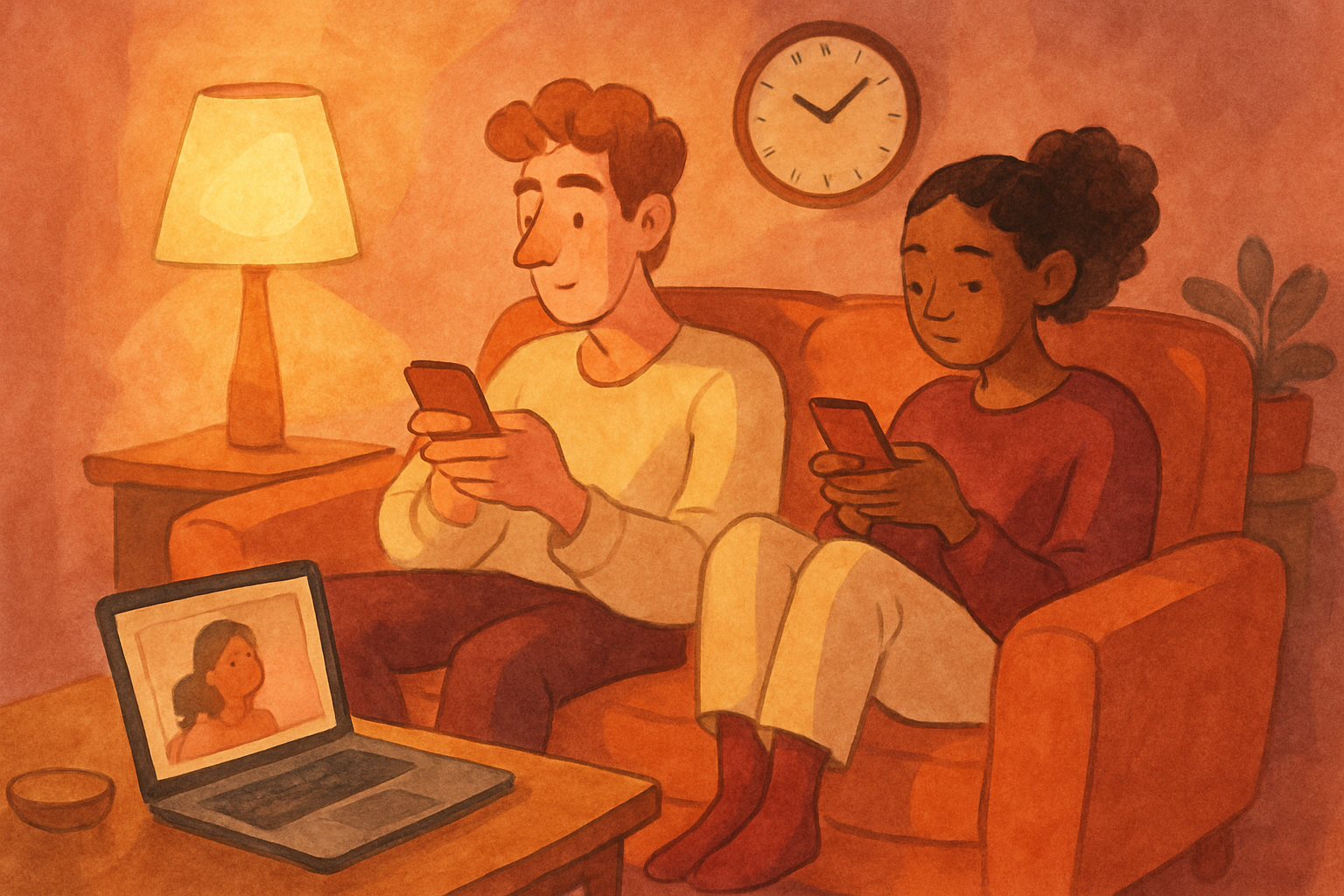
The miles aren't what break you. Neither is the time difference, the expensive flights, or even the stretches where you go longer than you'd like without seeing each other face to face. Ask anyone who's been through a long distance relationship — the real tests are quieter, more internal, and often catch you completely off guard.
Long distance relationship tips tend to focus on the logistics: schedule video calls, send care packages, plan visits. And sure, those things matter. But the couples who actually make it through the distance aren't just better at logistics. They're better at the invisible work — the self-awareness, the communication, the trust-building that happens in the space between visits. That's what this article is really about.
Why Do We Keep Framing Distance as the Enemy?
There's a cultural assumption baked into how we talk about long distance: that it's inherently harder than being in the same place, that it's something to endure or survive rather than something that can — weird as it sounds — actually accelerate your growth as a couple.
Here's what research suggests. A 2013 study published in the Journal of Communication found that long-distance couples reported higher levels of relationship quality, intimacy, and communication satisfaction than geographically close couples. Not because distance is magic, but because it forces deliberateness. Every conversation has to count. You can't coast on proximity.
What the study didn't cover is what most long-distance couples quietly discover: the geography isn't the main event. The main event is everything that distance magnifies — your attachment style, your communication patterns, your capacity for vulnerability, and your shared vision of the future.
What Actually Tests You (It's Probably Not What You Think)
Your Attachment Style Under Pressure
If you've ever found yourself spiraling because your partner took three hours to reply to a text, welcome to the attachment style awakening that long distance delivers to basically everyone.
Attachment styles in dating — whether you lean secure, anxious, or avoidant — are always present in relationships. But distance turns the volume up. Anxious attachers may find themselves constantly scanning for signs of disconnection. Avoidant attachers may actually feel relieved by the space at first, then confused when closeness is suddenly demanded during a visit. Secure attachers tend to handle the logistics better, but they're not immune to the strain either.
The good news: awareness is the whole game. Understanding your own patterns — and your partner's — transforms a frustrating loop of "why didn't they text back?" into something you can actually talk about. If you haven't explored your attachment style yet, that's genuinely one of the highest-ROI things you can do for a long distance relationship. It's also one of the things Pairloom's conversation games surface naturally — because knowing each other's emotional wiring changes everything about how you show up.
Communicating Without Context
In person, so much is communicated without words — a look, a hand on someone's shoulder, the fact that you can tell they're stressed before they even open their mouth. Long distance strips most of that away, which means the words have to work harder.
Learning how to communicate better in a relationship becomes non-negotiable when you're hundreds or thousands of miles apart. Tone doesn't translate in text. Sarcasm misfires. "I'm fine" over a video call when someone clearly isn't fine creates a weird standoff where neither person wants to push too hard through a screen.
The couples who navigate this well tend to share a few habits: they name their emotional state explicitly rather than hoping the other person picks up on it, they have a "flag" system for when a conversation is important enough to save for a real call (not a text chain), and they've gotten comfortable saying things out loud that in-person couples might just let the room absorb.
Practicing this kind of explicit, vulnerable communication isn't just a long distance survival skill — it's actually what makes relationships more intimate across the board. The distance forces you to develop it faster.
The Assumption Gap
One of the sneakiest relationship killers in long distance is what you might call the assumption gap. You're each living separate daily lives, growing and shifting in ways that don't get narrated in real time. Then you visit, or you finally close the distance, and there's this quiet shock of realizing the person has changed — or that you have.
This is where questions to ask your partner become more than a fun exercise. Regularly checking in about each other's evolving values, fears, goals, and daily textures isn't just nice to do — it's structural maintenance. Without it, you're each building a mental model of the other person that drifts further from reality the longer you go without updating it.
Some couples set aside intentional "state of us" conversations — not to troubleshoot problems, but just to share what's been moving them lately, what they've been thinking about, what's shifted. It sounds formal, but it's really just the antidote to assumption drift.
The Trust Conversation You're Probably Not Having
Trust in a relationship is often treated like a binary: either you have it or you don't. But in long distance, trust is actually a practice — something you actively build or quietly erode through small choices made over time.
The things that build trust in a long distance relationship aren't dramatic. They're consistency (saying you'll call and calling), honesty about the hard stuff (telling your partner when you're struggling instead of performing okayness), and repair (addressing tension quickly rather than letting it calcify over a week of awkward texts).
What erodes trust is equally unsexy: vagueness about your schedule, unresolved arguments that get tabled because "it's not worth a whole conversation over the phone," and the slow drift into performing a version of yourself that you think your partner needs to see rather than the actual you.
Vulnerability in relationships is the engine here. It's the thing that makes trust possible. And in long distance, where you can't rely on physical presence to soften moments of honesty, vulnerability requires a kind of deliberate courage that genuinely does make you better at relationships overall.
Are Your Dealbreakers Actually Dealbreakers, or Are They Distance Talking?
Here's a question worth sitting with: how much of what feels like relationship incompatibility right now is actually just the friction of the situation you're in?
Long distance creates a specific kind of pressure that can make real differences feel catastrophic and real problems feel like proof of fundamental incompatibility. It's worth slowing down to distinguish between relationship red flags vs differences — because conflating the two is one of the most common ways couples sabotage something good.
A red flag in a long distance relationship looks like: a pattern of dishonesty, consistent unavailability without explanation, feeling worse about yourself after most interactions, or a partner who has no interest in ever closing the distance.
A difference looks like: you process emotions differently, you have different communication rhythms, you need different amounts of alone time, or you're navigating genuinely hard life seasons that temporarily make you less available.
The former is information. The latter is something you actually talk through — ideally with curiosity rather than accusation. Figuring out which is which requires a level of self-awareness in dating that most people don't develop until they've been burned a few times. Long distance accelerates the curriculum.
What Makes Long Distance Couples Actually Last?
The research on what makes couples last consistently points to a handful of factors that have nothing to do with proximity: shared values, quality of communication, emotional safety, and a sense of shared future. Long distance, interestingly, stress-tests all of these faster than many in-person relationships do.
Couples who make it through distance tend to be explicit about the plan — not necessarily a rigid timeline, but a shared understanding that the distance has an end point and that they're both working toward it. Indefinite long distance with no roadmap is genuinely harder, not because the love isn't real, but because the absence of a shared direction creates a particular kind of ambient anxiety that compounds over time.
They also tend to be intentional about fun. Not just the heavy conversations about the future, but the lighter stuff — playing games together online, watching shows simultaneously, doing the kinds of things that remind you why you actually like this person, not just love them. Date night ideas at home don't have to be in the same home to count. Some of the most connecting things you can do are the ones that feel a little silly: playing a trivia game over video call, working through a shared list of questions, doing something that creates a shared experience even across a time zone.
This is one of the things Pairloom was actually built for — giving couples a structured, playful way to get to know each other on a deeper level, whether you're in the same city or not. It turns out that couples games to play together don't require a couch and a board. They require a little willingness to show up and answer honestly.
For more on building that kind of intentional connection, check out our piece on how to have deeper conversations with your partner — a lot of those principles apply even more in long distance.
The Homecoming Myth
Something nobody warns you about: visits can be harder than the distance itself.
After weeks or months of talking exclusively through screens, you arrive at the airport or the front door with enormous expectations — and then you spend the first hour feeling oddly awkward, like you have to get to know each other again. This is normal. It has a name in research circles: re-entry stress. And it catches a lot of couples off guard because it feels like it shouldn't be happening.
The visits where couples feel most connected are usually the ones where they've let go of the pressure to make every moment significant. Where they've just... cooked dinner together, run errands, done the ordinary stuff that reminds you what a real shared life feels like. The grand romantic gestures are lovely, but it's the mundane moments that actually close the distance.
If you're finding that visits feel high-stakes in a way that's stressful rather than exciting, that's worth naming with your partner. Healthy conflict in relationships isn't about fighting — it's about being able to surface what's actually going on without it becoming a crisis. You can read more about navigating that in our post on how to argue without damaging your relationship.
The Real Question Long Distance Is Asking You
Underneath all the logistics and communication tips and attachment style frameworks, long distance is really asking one question of both people involved: Are you choosing this relationship, actively, even when it's inconvenient?
That's a question every relationship asks eventually. Long distance just asks it every single day.
The couples who make it aren't necessarily the ones with the best Wi-Fi or the most frequent flyer miles. They're the ones who've decided that getting to know each other — really know each other — is worth the discomfort of the distance. And who keep showing up to do exactly that.
Stop wondering. Start playing.
Pairloom turns the conversations that matter into games you'll actually enjoy. Invite your partner and discover how you really connect — in minutes, not months.
Stop wondering. Start playing.
Pairloom turns the conversations that matter into games you'll actually enjoy. Invite your partner and discover how you really connect — in minutes, not months.