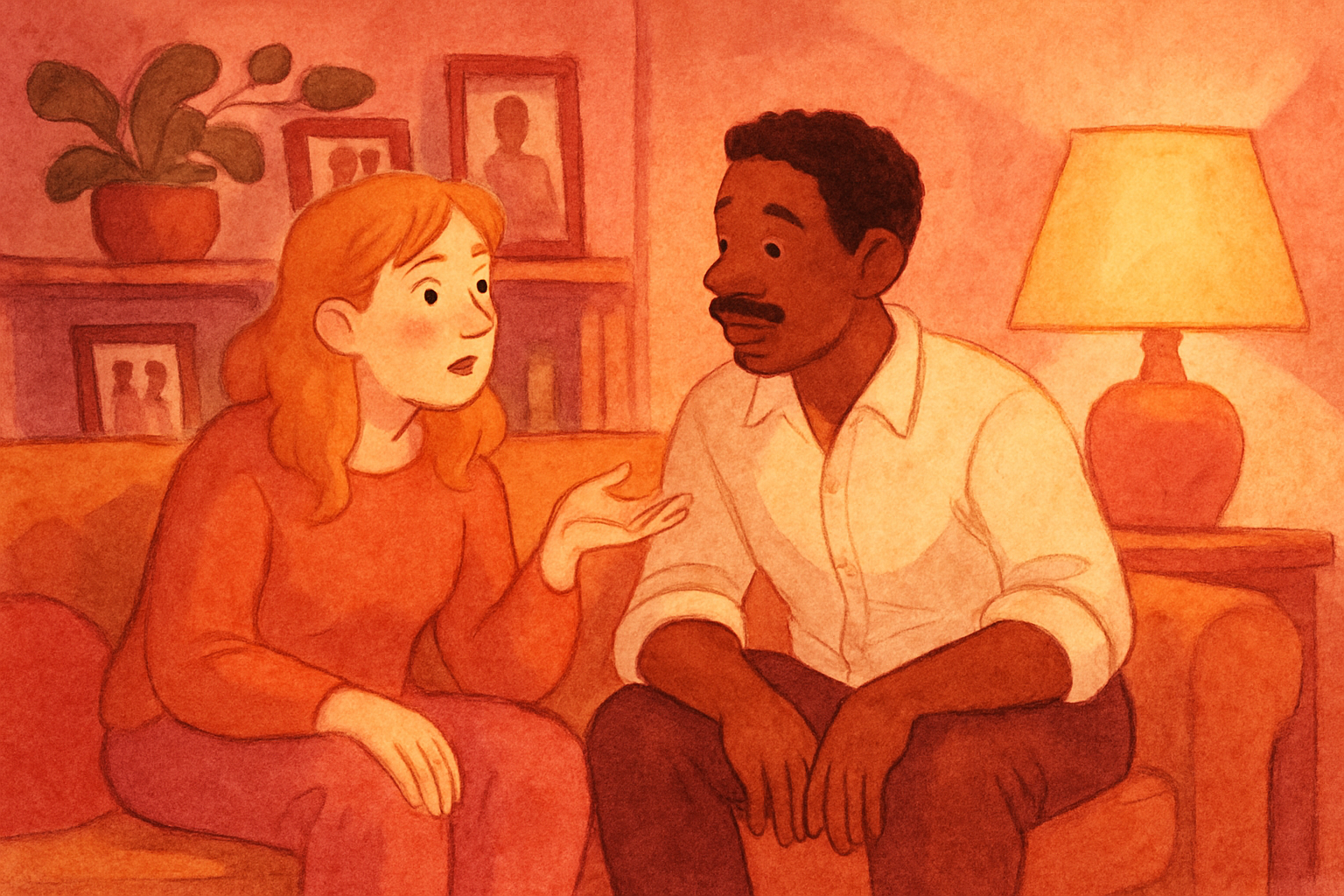
There's a version of settling that's easy to spot — staying with someone who treats you badly, ignoring obvious red flags, convincing yourself that cruelty is just "passion." But there's a quieter, far more common version that almost nobody talks about: staying with someone who is fine. Someone who checks most of the boxes. Someone who is kind, stable, available — and yet, deep down, you feel a low hum of dissatisfaction you can't quite name.
This is the hidden cost of settling. And it doesn't announce itself. It sneaks in wearing the costume of maturity, practicality, and "realistic expectations."
So how do you know if you're genuinely choosing someone — or just choosing the comfort of not being alone?
Why Settling Feels So Reasonable (At First)
The funny thing about settling is that it rarely feels like settling in the moment. It feels like growth.
You've been through the drama. The situationship that never went anywhere. The talking stage that lasted six months and ended in a screenshot and a block. The person you were completely electrified by who also made you feel terrible about yourself. So when someone comes along who is stable — who texts back, who shows up, who doesn't make you feel insane — your nervous system breathes a sigh of relief so deep it can feel like love.
And maybe it is love. That's the genuine complication here.
Comfort, safety, and reliability are actually features of a healthy relationship, not consolation prizes. The research backs this up: according to work stemming from John Gottman's decades of couples studies, emotional safety and predictability are among the strongest predictors of long-term relationship satisfaction. So we don't want to throw out comfort as worthless.
But there's a difference between a relationship that includes comfort and one that is only comfort. One is a foundation. The other is a hiding place.
What Are Your Actual Dealbreakers in a Relationship?
Here's where most people get tripped up: they've never actually articulated their dealbreakers clearly to themselves. They have a vague sense of what they don't want, usually shaped by past pain, but they haven't done the harder work of identifying what they genuinely need.
Dealbreakers in a relationship tend to fall into two categories:
1. Non-negotiable values misalignment — things like whether you want children, how you feel about religion or spirituality, your relationship with money, your need for social connection or solitude, and how you navigate conflict. These aren't preferences. These are the load-bearing walls of a partnership.
2. Lifestyle incompatibilities — things like different life visions (one person wants to travel constantly, the other wants deep roots), different communication styles that cause ongoing friction, or fundamentally different ideas about what a relationship should feel like.
Notice what's not on that list: different tastes in music, different morning routines, being at slightly different fitness levels, having different friend groups. Those are differences — and healthy relationships are full of differences. The problem isn't that you're different people. The problem is when people mistake differences for dealbreakers (causing them to bolt from something real) or dealbreakers for differences (causing them to rationalize something untenable).
If you haven't spent real time thinking about what your actual non-negotiables are — not inherited from your parents, not shaped by your worst ex, but genuinely yours — it's worth doing that work. Pairloom's reflection prompts are specifically designed to help you excavate those values, which is a lot more useful than yet another personality quiz.
The Signs You're Choosing Comfort Over Compatibility
This is the question that takes some courage to sit with honestly. Here are some patterns worth paying attention to.
You feel relieved, not excited
There's a specific emotional flavor to choosing comfort over connection: the dominant feeling is relief. Relief that the search might be over. Relief that someone wants you. Relief that you don't have to be on dating apps anymore (more on dating app fatigue in another post, because it is real and it matters).
Excitement and relief are both valid feelings — but if excitement is mostly absent, that's data worth examining. Early relationships should have some aliveness to them, some curiosity, some genuine "I want to know more about this person." If you're mostly just... comfortable, it's worth asking why.
You find yourself explaining away your doubts
"Nobody's perfect." "I'm probably being too picky." "My therapist said I have unrealistic expectations." "This is just what adult relationships feel like."
Some of these reframes are genuinely useful — unrealistic expectations do exist, and not every relationship needs to feel like a Nicholas Sparks novel. But when you find yourself explaining away the same doubts repeatedly, over months, to multiple friends, in your journal — the doubts aren't going away because they're wrong. They're staying because they're trying to tell you something.
You avoid imagining the future
Couples who are genuinely compatible tend to naturally build shared futures in their minds. They reference "when we travel someday" and "what our apartment might look like." It's not forced planning — it's an organic orientation toward a shared horizon.
If you find yourself flinching away from imagining a long-term future with this person — not because you're afraid of commitment in general, but specifically with them — that's worth noticing. So is the opposite: feeling vaguely relieved when plans fall through, or craving solo time in ways that go beyond normal introversion.
You feel lonelier with them than without them
This one is perhaps the clearest signal of all. Real relationship compatibility doesn't eliminate loneliness entirely (no person can do that), but it shouldn't consistently add to it. If you regularly feel unseen, unheard, or like your full self doesn't fit into the space this relationship creates, that's not just a communication problem to be solved. It's a fundamental incompatibility in how you both understand intimacy.
Relationship Red Flags vs. Differences: Learning to Tell Them Apart
One reason people stay in comfortable but mismatched relationships is genuine confusion about what actually constitutes a problem. Not everything that bothers you is a red flag. But not everything uncomfortable is a growth opportunity either.
A useful framework: red flags involve behavior patterns that compromise your safety, dignity, or core values. Differences involve preferences, habits, and styles that require negotiation but don't threaten the foundation of the relationship.
Red flags worth taking seriously:
- Consistent dishonesty or opacity, even about small things (this is about trust in a relationship, which is genuinely foundational)
- Contempt — the feeling that your partner looks down on you, dismisses you, or mocks things you care about
- An inability or unwillingness to take responsibility for their impact on you
- A pattern of making you feel bad for having needs or emotions
- Values misalignment on your actual non-negotiables
Not red flags, just differences:
- Different conflict styles that can be learned and adjusted
- Different love languages (one partner is more physically affectionate, the other expresses love through acts of service)
- Different social needs or friendship dynamics
- Different paces of emotional openness — some people are slower to vulnerability in relationships and that's okay, as long as there's movement
The key question isn't "is this person perfect?" It's "are the things that don't work between us workable, or are they fundamental?"
What Genuine Compatibility Actually Looks Like
This is where it's important to resist the trap of thinking real compatibility means effortless perfection. It doesn't. Every lasting relationship has friction, misunderstanding, and seasons where the connection feels thin.
What research on what makes couples last consistently shows is that compatible couples share:
A mutual orientation toward growth. Both people are willing to be changed by the relationship — to learn, adapt, and become better versions of themselves because of this partnership, not in spite of it.
Shared core values, not shared surface preferences. You don't have to love the same music or even have the same lifestyle vision from the start. But you need to fundamentally agree on things like how you treat people, what integrity means, and what a good life looks like.
A baseline of emotional safety. The ability to say something vulnerable — something embarrassing, uncertain, or difficult — and feel received rather than judged. This is the foundation of genuine trust in a relationship, and it can't be faked long-term.
The ability to repair after conflict. Not the absence of conflict — all couples have it — but the ability to return to each other afterward, to apologize genuinely, to move forward without accumulating resentment. This is what healthy conflict in relationships actually means: not that you never fight, but that you know how to come back.
If you want to actually test these things — in a way that's honest and low-stakes — exploring structured questions together is one of the best ways to do it. The questions to ask your partner that matter most aren't the romantic ones. They're the slightly uncomfortable ones about values, fears, and what you really want your life to look like.
How to Stop Settling Without Becoming Commitment-Avoidant
There's a real danger in articles like this one: they can become ammunition for the part of you that wants to run at the first sign of difficulty. So let's be clear about something.
Choosing to leave a comfortable but unfulfilling relationship is not the same as believing you deserve butterflies indefinitely or that love should always be easy. And staying in a relationship to do the real work of building something is not the same as settling.
The question is about intention and honesty. Are you staying because you genuinely believe in what you're building? Or are you staying because leaving feels harder than staying?
Self-awareness in dating — including self-awareness within a relationship — is the real work here. It means being honest with yourself about your attachment patterns (if you've never explored your attachment style in dating, it's illuminating — anxious attachment can make you cling to comfort, avoidant attachment can make you run from it). It means knowing your dealbreakers before you're deep in a relationship and emotionally invested. And it means being willing to ask the harder questions early, even when the relationship still feels new and uncertain.
Some of the best ways to do that? Games and prompts that make those conversations feel less like a performance review and more like genuine discovery. That's exactly the kind of space Pairloom creates — structured conversations designed to help you and a partner (or a potential partner) actually understand each other, not just perform for each other.
The Real Question Underneath All of This
At its core, the question of settling vs. choosing isn't about whether someone is "good enough." It's about whether you're being honest with yourself about what you actually want and need — and whether you're brave enough to hold out for that, even when comfort is right in front of you.
Comfort is not nothing. But it's not everything either.
You deserve a relationship where you feel genuinely seen, where your real self fits, where the future you imagine together excites rather than exhausts you. That's not a fantasy standard. That's a reasonable baseline for a partnership worth choosing.
And the only way to get there is to be willing to ask — honestly, and without flinching — whether what you have right now is a choice, or just the path of least resistance.
Stop wondering. Start playing.
Pairloom turns the conversations that matter into games you'll actually enjoy. Invite your partner and discover how you really connect — in minutes, not months.
Stop wondering. Start playing.
Pairloom turns the conversations that matter into games you'll actually enjoy. Invite your partner and discover how you really connect — in minutes, not months.