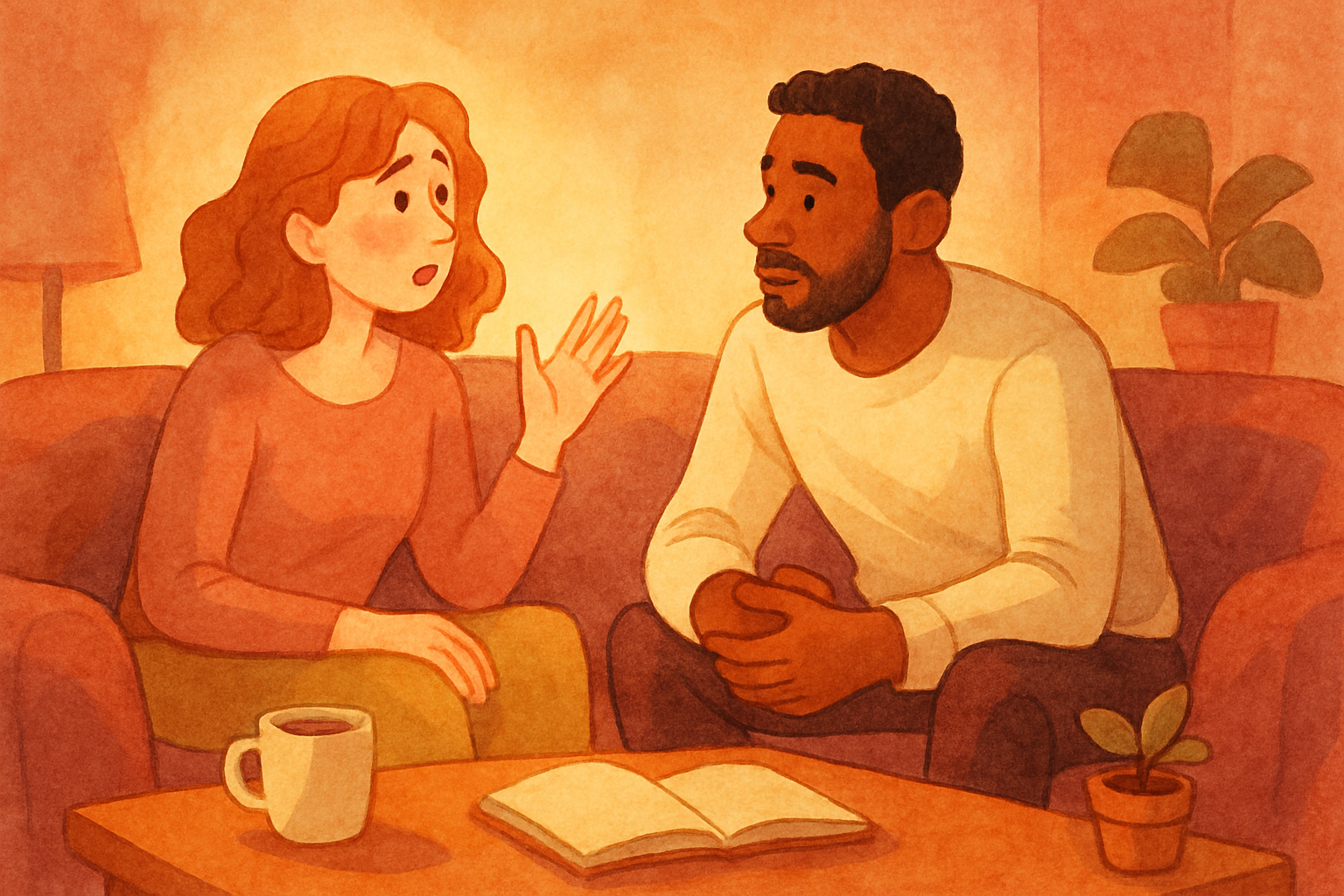
There's a moment most of us have experienced: you're a few months into dating someone and you notice something about them that makes you pause. Maybe they're conflict-avoidant in a way that frustrates you. Maybe they have very different spending habits. Maybe they never want to go to bed before midnight and you're a 10pm person. And you find yourself wondering — is this a red flag, or is this just… a difference?
That question matters more than most people realize. Misreading it can lead you to abandon relationships that had real potential, or worse, stay in ones that are genuinely harmful. So let's actually dig into what the research says, and how to tell the difference between relationship red flags vs differences with a clearer head.
Why We Get This Wrong So Often
Here's the uncomfortable truth: we're not great at distinguishing between personality differences and actual warning signs, especially early in a relationship. Part of this is emotional. When we really like someone, we minimize things that should concern us. When we're uncertain, we catastrophize things that are actually pretty normal.
Psychologist John Gottman's decades of research on couples found that the biggest predictor of relationship failure isn't how often couples disagree — it's how they handle disagreement, and whether certain negative patterns (what he called the "Four Horsemen") are present: contempt, criticism, stonewalling, and defensiveness. Notice that none of those are "having different hobbies" or "preferring different social schedules."
That distinction — between how someone treats you and engages with conflict versus what they happen to like or believe — is the foundation of understanding relationship red flags vs differences.
## What Actually Qualifies as a Red Flag?
The term "red flag" has gotten so overused that it's lost a lot of its meaning. Some people on the internet will tell you that a person not using the right emoji cadence is a red flag. It's not. Let's be real about what the research and clinical psychology actually point to.
Genuine red flags tend to cluster around:
- Patterns of dishonesty. Not one awkward lie about being late — but a consistent pattern of deceiving you about meaningful things.
- Contempt and belittling. This one is huge. Contempt — treating you as inferior, mocking you, eye-rolling during conversations — is one of the strongest predictors of relationship breakdown Gottman's lab ever identified.
- Refusing accountability. Someone who cannot, ever, take responsibility for their behavior or acknowledge when they've hurt you — that's a structural problem, not a quirk.
- Controlling behavior. Needing to know where you are constantly, getting angry when you make decisions independently, isolating you from friends or family.
- Escalating disrespect. Arguments that cross into name-calling, humiliation, or anything that makes you feel small or unsafe.
These aren't matters of preference or compatibility. They're patterns of behavior that directly undermine the psychological safety that healthy relationships require. Trust in a relationship cannot be built when these dynamics are present.
## What Counts as Just a Difference?
Here's where people genuinely struggle — and often where the concept of dealbreakers in a relationship gets muddled.
Differences are things like:
- You're an extrovert; they recharge alone.
- You want kids; they're unsure (note: unsure is different from a definitive "no").
- You're close with your family; they have more distance from theirs.
- You're spontaneous; they need more structure.
- You handle conflict by wanting to talk immediately; they need time to process first.
None of those are red flags. They're compatibility challenges — some of which are solvable, some of which require honest conversation, and a few of which may genuinely be dealbreakers for you. But a dealbreaker is a values or life-direction mismatch, not a character flaw or a sign someone is dangerous.
The key question to ask yourself: Is this difference causing harm, or is it causing friction? Friction can be worked through. Harm is a different story.
## How Attachment Styles Muddy the Water
One of the sneakier reasons we misread differences as red flags — or ignore actual red flags — is attachment styles in dating.
Attachment theory, originally developed by John Bowlby and later expanded by researchers like Dr. Amir Levine and Rachel Heller, describes how our early experiences with caregivers shape the way we relate to romantic partners as adults. There are three primary styles: secure, anxious, and avoidant (with some people falling into a fourth, disorganized, category).
If you have an anxious attachment style, you're wired to scan for threats to the relationship. This means normal avoidant behavior from a partner — needing space, taking longer to text back, being emotionally reserved early on — can feel like a five-alarm fire when it's actually just… how they are. You might label their natural emotional pace as a red flag when it's really just a difference in how they attach.
Conversely, someone with an avoidant style might dismiss actual red flags in a partner because engaging with them would require the kind of emotional closeness that feels threatening.
Self-awareness in dating — knowing your own attachment patterns — doesn't just help you understand yourself. It helps you calibrate your read of other people more accurately.
## The Role of Values Versus Vibes
There's an important distinction between value differences and vibe differences.
Values differences tend to be things like: how you handle money, whether you want a family, your views on commitment and fidelity, how much you prioritize religion or spirituality, your relationship to work and ambition, and how you define fairness in a partnership. These run deep. A big enough values gap isn't a red flag, but it can absolutely be a dealbreaker — and there's no shame in that.
Vibe differences tend to be things like: taste in music, how clean someone keeps their car, how much they use social media, how often they want to go out. These are real, but they're often more workable than we think — or less workable than we're willing to admit because they seem trivial.
The mistake people make is treating vibe differences as moral failings ("they're so messy, what does that say about them as a person?") or treating value differences as just preferences ("sure, we disagree about whether we want kids, but I can probably change his mind"). Neither of those is accurate.
## Questions That Help You Actually Figure It Out
One of the most grounding things you can do when you're trying to figure out if something is a red flag or a difference is simply ask better questions to ask your partner. Not interrogation — genuine curiosity.
Some worth exploring:
- "When we disagree about something, what does resolution look like for you?"
- "What's something you've changed your mind about in a previous relationship?"
- "How do you typically handle it when someone upsets you?"
- "What does feeling respected look like to you?"
The answers matter less than the quality of the engagement. Is the person thoughtful? Are they curious about your perspective in return? Or do they get defensive, dismissive, or turn it back on you in a way that feels destabilizing?
Healthy conflict in a relationship doesn't mean never arguing. It means both people can sit in some discomfort, take ownership of their part, and come back to connection. How to argue without fighting is less about technique and more about whether both people actually want a resolution.
## The "Pattern, Not Incident" Rule
One of the most useful frames for cutting through the noise: ask whether what you're seeing is an incident or a pattern.
Everyone has bad days. Everyone says something unkind once in a while. Everyone pulls away during periods of stress. A single incident — even a fairly significant one — is rarely definitive. What matters is what happens around it: Did they acknowledge it? Did they repair? Did it happen again?
A pattern, on the other hand, is when the same behavior repeats without acknowledgment or change. That's when you're looking at character, not circumstance.
This is also where vulnerability in relationships becomes important. When someone hurts you and you express it, a partner who is safe will feel bad about it — not necessarily guilty in a destructive way, but genuinely concerned about your experience. A partner who responds with "you're too sensitive" or immediately flips the script has just given you real information about whether trust in a relationship can actually be built with them.
## When You're Not Sure, Get Curious — Not Certain
The urge to know right now whether something is a red flag is completely understandable. But premature certainty — in either direction — is often what gets people into trouble. Deciding someone is perfect too early makes you blind to things that matter. Deciding someone is dangerous too early makes you abandon relationships that could have been genuinely good.
How to communicate better in a relationship often starts before the relationship is even serious — it starts in the talking stage of dating and extends into how you navigate the early months. Building that communication muscle early, through things like honest questions, playful conversation, and actually paying attention to how a person responds under low-stakes pressure, gives you so much more useful information than trying to assess someone through their dating profile alone.
If you're currently navigating dating app fatigue or feeling burned by too many connections that went nowhere, it's worth asking whether part of the issue is miscalibrated pattern recognition — seeing threats that aren't there, or missing signals because you're exhausted.
The antidote isn't just more time. It's better quality of attention and conversation. Which is exactly what tools like Pairloom's couples games are designed to help with — creating structured, low-pressure contexts for the kind of getting to know your partner conversations that actually reveal character, values, and the subtle things that matter most.
## So: Red Flag or Just Different?
Here's a quick gut-check framework:
| It might be a difference if… | It might be a red flag if… |
|---|---|
| It's about preference, habit, or lifestyle | It's about how they treat you or others |
| You can see their perspective, even if it's not yours | Their behavior makes you doubt your own perception |
| The pattern hasn't repeated after conversation | It's happened multiple times without acknowledgment |
| You feel safe raising it | You feel scared or anxious to bring it up |
| It causes friction but not harm | It causes you to feel small, unsafe, or unseen |
Relationship compatibility isn't about finding someone identical to you. It's about finding someone whose differences you can work with, who treats you with consistent respect, and who can navigate the inevitable rough patches without making you feel like the problem.
The signs you are compatible with someone aren't about matching perfectly on every surface-level thing. They're about alignment on values, mutual curiosity about each other, and a shared willingness to show up even when it's uncomfortable.
That's the stuff that actually matters.
Stop Wondering. Start Playing.
Pairloom turns the conversations that matter into games you'll actually enjoy. Invite your partner and discover how you really connect — in minutes, not months.
Stop wondering. Start playing.
Pairloom turns the conversations that matter into games you'll actually enjoy. Invite your partner and discover how you really connect — in minutes, not months.