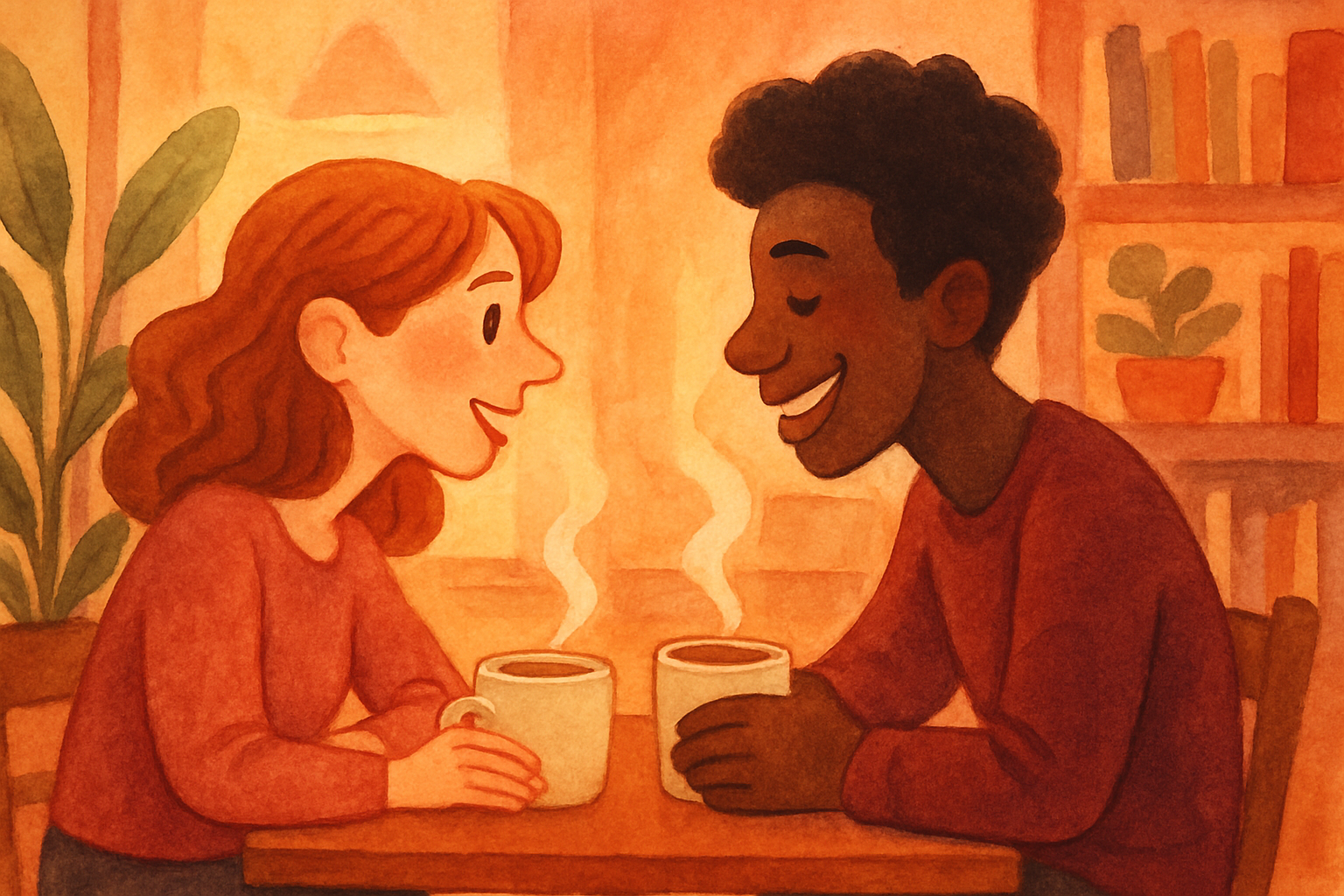
There's a moment in early dating that most of us know well. You're sitting across from someone at dinner, the conversation is flowing, the eye contact is lingering just a little longer than it needs to, and everything feels right. The vibe is undeniable.
Then, somewhere around date three or four, you find out they don't want kids. Or they think emotional vulnerability is weakness. Or their financial relationship to life looks nothing like yours. And suddenly, all that electric chemistry starts to feel like a very pretty picture frame around a completely blank canvas.
This is the values-versus-vibe trap — and it catches more people than almost any other pattern in modern dating.
## Why the "Vibe" Gets So Much Credit (And Why That's a Problem)
We're wired to respond to chemistry. The science of attraction is pretty clear on this: when you meet someone who triggers novelty, physical appeal, and social confidence all at once, your brain lights up like a pinball machine. Dopamine, norepinephrine, serotonin — the whole cocktail kicks in and it feels like information. Like your body is telling you something true.
And it is telling you something. Just not necessarily what you think.
Chemistry tells you there's potential energy. It doesn't tell you whether two people share a vision for their lives, handle conflict with any degree of maturity, or hold compatible beliefs about what a relationship should actually look like day-to-day.
The problem with the talking stage of modern dating — those early weeks of texting, first date ideas, and getting-to-know-you conversations — is that it's almost entirely optimized for vibe. Dating apps serve you a photo and a one-liner. You meet for coffee. You talk about your jobs and your favorite shows and how much you love traveling. Everything feels light and fun and possible.
What you're not usually doing is having the conversations that would actually help you understand whether this person is compatible with you at a foundational level.
## What Are Dealbreakers in a Relationship, Really?
The phrase "dealbreakers in a relationship" gets used a lot — but it's worth slowing down on what it actually means, because most people confuse dealbreakers with preferences.
A preference is something like: you'd love it if they liked hiking, or cooked dinner at home sometimes, or laughed at the same kind of humor you do. These things are great when they align. When they don't, you can usually bridge the gap or find a middle ground.
A dealbreaker is different. It's a fundamental incompatibility — a divergence in core values, life goals, or non-negotiable boundaries that, if unaddressed, will become a slow structural crack in the foundation of the relationship. These tend to fall into a few big categories:
- Life-path values: Do you want children? Where do you want to live? What does your ideal life look like in ten years?
- Relational values: How do you define commitment? What does loyalty mean to you? How much independence do you need versus togetherness?
- Conflict and communication style: Can you disagree without it becoming a war? Do you shut down or blow up? Is repair something you both know how to do?
- Financial values: Not how much money someone makes, but their relationship to money — security, generosity, risk tolerance.
- Growth and self-awareness: Are they someone who reflects and evolves, or are they fundamentally resistant to looking inward?
Notice that none of these show up in a great vibe. You can have an amazing first date with someone and know absolutely nothing about where they fall on any of these.
## The Research on What Actually Makes Couples Last
Relationship researchers have spent decades studying what makes couples last, and the findings consistently point away from initial chemistry and toward something more structural.
Psychologist John Gottman's long-term research identified that couples who stay together aren't necessarily the ones who never fight — they're the ones who fight well. Healthy conflict in relationships, where both people feel heard and the goal is resolution rather than winning, turns out to be one of the strongest predictors of relationship longevity.
Similarly, research on relationship compatibility suggests that shared values — particularly around family, finances, and lifestyle — are far more predictive of long-term satisfaction than personality similarity or initial attraction. Two people can have wildly different tastes in music and food and still build an extraordinary life together. But two people who want fundamentally different things? That gap doesn't usually close on its own. It widens.
The early dating phase is actually the best time to surface these conversations — not to be interrogative or interview-style about it, but to be genuinely curious. Understanding your own attachment styles in dating is part of this too, because how you attach affects what you need from a partner and what feels threatening when it's missing.
## How "Relationship Red Flags vs Differences" Gets Confused
One of the most useful frameworks for thinking about compatibility is learning to distinguish between actual relationship red flags and things that are just differences.
A difference might be: one of you is an introvert and one of you is more social. Or you grew up in different cultural or religious traditions. Or you have different communication cadences — one of you texts back quickly, the other takes a few hours. These things require conversation and adjustment, but they're workable.
A red flag looks different. It's a pattern that points toward something deeper — a consistent dismissiveness about your feelings, a resistance to any accountability, a tendency to rewrite history in arguments, an inability to show up during hard moments. These aren't quirks. They're signals about how someone moves through intimacy and conflict.
The danger is that when the vibe is strong, red flags get reframed as differences. He's just protective, not controlling. She's just passionate, not actually angry. The chemistry creates a kind of interpretive haze — and the longer you're in it without having substantive conversations, the harder it gets to see clearly.
This is especially relevant in what a lot of people are calling the situationship era of dating. When connection lives mostly in the talking stage and never quite formalizes, it becomes easy to maintain the vibe indefinitely while never actually interrogating the values underneath. You keep things light because getting deep feels like pressure. But light doesn't tell you whether this person is someone you can actually build something with.
## How to Actually Surface Values Early (Without It Feeling Like a Job Interview)
Here's the good news: talking about values doesn't have to be heavy or awkward. In fact, the most effective approach is usually woven into natural conversation through the right kinds of questions.
Questions like:
- "What does your ideal Sunday look like — like genuinely your happiest version of it?"
- "Is there anything you've changed your mind about in the last few years?"
- "How do you and your close friends handle it when there's conflict between you?"
- "What does home mean to you?"
- "What's something you need from a relationship that you don't always know how to ask for?"
These aren't interrogations. They're invitations. And they tell you an enormous amount — not just in the content of what someone says, but in how they engage with the question. Do they go deep, or do they deflect? Are they curious about your answer too, or is it one-directional? Questions to ask your partner early on aren't a checklist — they're a window into how someone thinks about themselves and relationships.
Self-awareness in dating is a two-way street, too. Before you can evaluate someone else's values clearly, you need to know your own. What are your actual dealbreakers? Not the ones you inherited from other people's expectations, but the ones that come from knowing yourself? And equally important — what are things you've labeled as dealbreakers that are actually just preferences?
Getting honest with yourself about that distinction changes everything about how you date.
## The Role of Vulnerability in Values Conversations
There's a reason values conversations feel harder than vibe conversations: they require vulnerability in relationships. To say "I really want to get married someday" or "I know I need a partner who can handle conflict directly because avoidance shuts me down" is to risk being judged or rejected for who you actually are.
But here's the reframe: that vulnerability isn't a liability. It's a filter.
When you share something real and the other person either matches that energy or creates a safe space for it, that's information. That's someone showing you they can handle depth. And when someone responds with dismissiveness, a pivot to something lighter, or an expression that suggests your honesty made them uncomfortable — that's information too. Important information. The kind that can save you months.
The couples who navigate long-term relationships successfully — who manage to communicate better through hard seasons and grow through conflict rather than apart from it — tend to be people who developed the habit of vulnerability early. Not oversharing, but being willing to be real about what they want and need and believe.
This is actually something you can practice. Not in a performative way, but by gradually letting someone in on the things that matter most to you — and paying close attention to how they hold what you share.
## Date Night Ideas That Actually Help You Go Deeper
Here's something practical: some of the best date night ideas at home or low-key first date ideas are ones that naturally create space for real conversation. Not dinner at a loud restaurant where you're performing for each other, but something that slows you down.
Cook a meal together (few things reveal how someone handles mild stress and collaboration better than navigating a kitchen). Take a long walk without a destination. Play a game that asks you to actually answer things about yourself.
That last one is worth lingering on. Couples games to play together — particularly ones built around questions that matter — are surprisingly effective at accelerating real connection. Not because they make you vulnerable artificially, but because they create a structure that makes it easier to go places conversation doesn't naturally go. The laughing, the surprise, the "I can't believe you said that" moments — they create intimacy and they reveal character, all at the same time.
Pairloom was built around exactly this idea. Instead of you trying to figure out the right questions to ask or engineering the perfect conversation, the games do the scaffolding — surfacing values, communication styles, and preferences in a way that feels playful rather than pressured. Whether you're in the early talking stage or several months in and realizing there are still things you don't know about each other, it's a genuinely useful way to close that gap.
## The Bottom Line
The vibe isn't irrelevant. Chemistry matters, and you should feel something. But it's not enough — and learning to treat it as the beginning of an investigation rather than the conclusion of one is one of the most useful shifts you can make in how you approach dating.
Values are where the real story lives. They're what determines whether two people can actually build something together when the novelty fades and real life sets in. And the earlier you start paying attention to them — with curiosity instead of anxiety — the better positioned you are to find something that actually lasts.
Stop wondering. Start playing.
Pairloom turns the conversations that matter into games you'll actually enjoy. Invite your partner and discover how you really connect — in minutes, not months.
Stop wondering. Start playing.
Pairloom turns the conversations that matter into games you'll actually enjoy. Invite your partner and discover how you really connect — in minutes, not months.