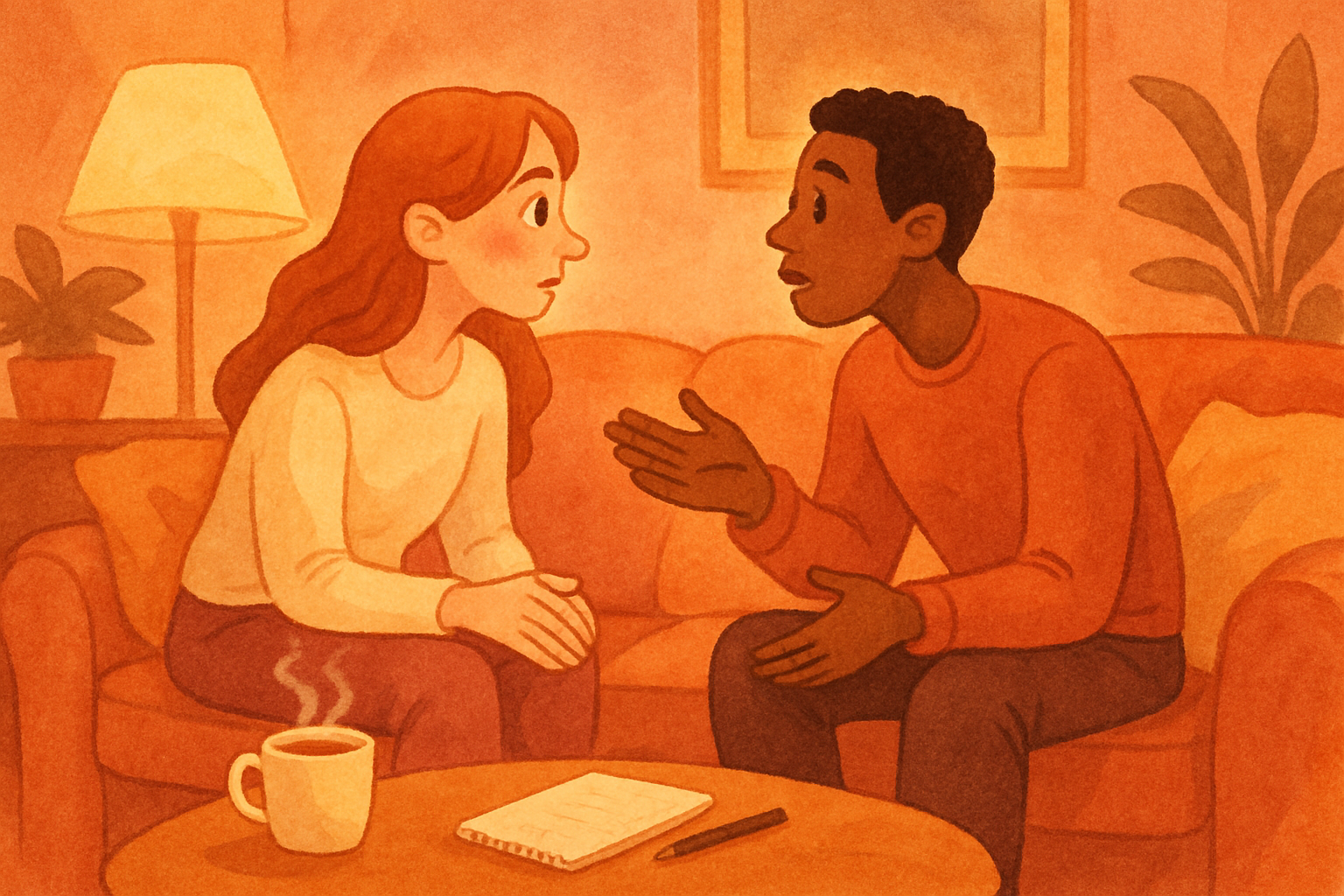
There's a moment most couples recognize but few talk about. You're sitting across from the person you love — maybe at dinner, maybe on the couch — and the silence isn't comfortable anymore. It's just... empty. You're not fighting. You're not distant in any dramatic way. You've just quietly run out of things to say.
It's one of the most common relationship problems nobody warns you about. And ironically, it rarely has anything to do with how much two people love each other.
So what actually happens? And more importantly — what do you do about it?
Why Communication Breaks Down in the First Place
Early in a relationship, conversation feels effortless. You're learning about each other constantly. Everything the other person says is new information, and novelty is genuinely exciting to the brain. Researchers have found that the dopamine surge associated with new romantic connections mirrors the response to other reward-driven behaviors — you're literally wired to find your new partner fascinating.
But novelty fades. That's not a flaw in your relationship; it's just biology doing its thing.
The problem isn't the fading itself. It's what couples replace those early conversations with — or fail to replace them with. Research on long-term relationships consistently shows that couples who stop asking each other real questions start operating on assumptions. You think you know what your partner is thinking. They assume they know what you need. And slowly, without anyone deciding to, you both stop trying to find out.
Psychologist John Gottman's decades of research on couples identified something he called "turning toward" — the small, everyday moments when one partner makes a bid for connection (a comment, a question, a touch) and the other either engages or pulls away. Couples who regularly "turn toward" each other don't need grand romantic gestures to stay close. They just need consistent, small moments of genuine attention.
When those moments disappear, the distance isn't dramatic. It's quiet. And quiet is harder to fix, because there's no obvious moment to point to as the problem.
The Talking Stage Never Really Ends (It Just Gets Neglected)
Here's something worth sitting with: the talking stage — that early period of dating where you're endlessly curious about each other — doesn't have to stop when the relationship becomes official. It stops because people let it stop.
Couples in long relationships often joke that they've "run out of questions." But that's almost never true. What they've run out of is the habit of asking them.
Think about how much you've changed in the last year alone — your thinking on work, your relationship with your family, what stresses you out, what you secretly want. Your partner has changed too. The version of them you fell for is not exactly the person sitting across from you today. That's not sad — it's actually an invitation to keep getting curious.
The couples who stay genuinely connected long-term aren't the ones who happened to be perfectly compatible from the start. They're the ones who kept asking questions, even when — especially when — they thought they already knew the answers.
How to Communicate Better in a Relationship: It's Not About Talking More
When people hear "communicate better," they often assume it means talking more. Longer conversations. More check-ins. More emotional processing sessions. But research doesn't really support that. What matters isn't volume — it's quality and safety.
Quality means the conversations you're having actually reveal something real. Not logistics. Not schedules. Not rehashing the same surface-level topics. Real conversations surface values, feelings, fears, dreams — the stuff that creates actual intimacy.
Safety means both people feel like they can say something honest without the conversation blowing up, shutting down, or ending in a score-keeping argument.
If you've ever held back something true because you were afraid of how your partner would react, you already understand what low psychological safety feels like in a relationship. And if that happens often enough, you both start self-editing automatically — until one day, you realize there's a whole interior world you've stopped sharing.
The fix isn't a communication course or a relationship workbook (though those can help). The fix is a habit — something small and repeatable that creates regular openings for real conversation.
The Simple Habit That Actually Works
The habit is almost embarrassingly basic: ask a question you don't know the answer to. Every day.
Not "how was your day" (you both know what that answer usually sounds like). Not "are you okay?" (usually answered with "fine"). A real question. Something that requires your partner to think, and invites them to share something they haven't shared yet.
This is sometimes called "active curiosity," and the research behind it is surprisingly robust. Studies on relationship satisfaction consistently find that partners who demonstrate genuine interest in each other's inner lives — not just their schedules — report higher levels of closeness, trust, and overall relationship quality.
The tricky part is that most people don't have a ready supply of interesting questions. That's where couples games and conversation tools come in — not as a replacement for authentic connection, but as a scaffold for it. When you remove the pressure of "coming up with something meaningful to say," you're free to just... actually engage.
What Gets in the Way (Beyond Busyness)
Busyness is the excuse, but it's rarely the real reason couples stop talking. Here's what's usually underneath it:
Fear of conflict
Some couples go quiet not because they have nothing to say, but because they're afraid of what might happen if they do. When conflict has gone badly in the past — when arguments turned into attacks, or when silence was used as a weapon — the safer option starts to feel like saying nothing at all.
This is where understanding attachment styles in dating becomes genuinely useful. Avoidant partners often retreat from emotional conversations not because they don't care, but because conflict registers as a threat to the relationship itself. Anxiously attached partners might flood conversations with feeling in a way that shuts down their partner. Knowing your own pattern doesn't excuse it — but it gives you somewhere to start.
Assuming you already know
There's a cognitive phenomenon sometimes called "mind-reading" — and we all do it, especially with people we're close to. We fill in the blanks of what our partner is thinking or feeling based on past patterns, and then we respond to our assumption rather than to them.
It's efficient, but it's lethal to intimacy. The moment you stop being genuinely curious about your partner, you stop really seeing them. And people who feel unseen in relationships don't usually announce it — they just quietly withdraw.
The smartphone problem
You probably don't need research to confirm this one, but the research exists: couples who spend more time on their phones during shared time together report lower relationship satisfaction and lower feelings of partner responsiveness. The problem isn't the phone exactly — it's that the phone is always offering something slightly more stimulating than a quiet Tuesday evening with someone you've lived with for three years.
The habit of active curiosity has to be deliberately protected from distraction. Even fifteen minutes of genuine, device-free conversation can shift the tone of a whole evening.
Signs You're Compatible — and Why They Don't Show Up in Small Talk
One thing that gets lost when couples stop having real conversations is the ongoing discovery of compatibility. People often think of relationship compatibility as something you assess early and then just have or don't have. But compatibility is actually something that's continuously revealed and continuously built.
The signs you are compatible with someone aren't things like "we like the same movies" or "we both stay up late." They're things like: Does this person's vision of a good life overlap with mine? Do we handle stress in ways that complement rather than clash? Do we want the same things from the future — not in a vague way, but in the specific, textured, real way?
You can't discover any of that through logistics conversations. You need real questions. You need the kind of conversations that feel slightly vulnerable — where both people are saying something true and a little bit exposed.
That vulnerability, by the way, is not a weakness in a relationship. According to researcher Brené Brown's extensive work on human connection, vulnerability is the actual mechanism through which intimacy forms. You can't feel close to someone who never lets you see them. And they can't feel close to you if you won't be seen.
Turning This Into a Practice (Not a Project)
The mistake most couples make when they realize they've drifted is treating the fix like a project. They schedule a "relationship talk," which immediately feels heavy and serious, and then either it goes sideways or it feels forced and they abandon the effort.
A better approach is to treat reconnection as a practice — low-stakes, recurring, and slightly playful when possible.
Some ideas that actually work:
-
The "high/low/interesting" check-in: Instead of "how was your day," each person shares the high point, low point, and something interesting they noticed or thought about. It's structured enough to bypass autopilot but open enough to go anywhere.
-
Question cards or games: Tools like Pairloom's couples games are designed exactly for this — they give you conversation prompts that feel like play rather than homework. Getting to know your partner through a game format removes the pressure of "we need to talk" and replaces it with genuine curiosity and usually a lot of laughing.
-
The weekly question ritual: Each week, one person comes up with a question neither of them has ever asked before. It can be light, it can be deep — the only rule is that it has to be something you genuinely don't know the answer to.
-
The phone-free window: Pick 20-30 minutes a day — dinner, a walk, lying in bed before sleep — where phones are away and conversation is just available. You don't have to fill it with deep talk every night. Just make the space.
What Long-Distance Couples Know That Everyone Else Should
Here's an interesting data point: couples in long-distance relationships often report higher levels of relationship quality and intimacy than cohabiting couples — at least in the short term. The leading explanation from researchers is that distance forces intentionality. You can't rely on physical proximity or shared routines to generate closeness. You have to create it, through conversation and deliberate connection.
Long distance relationship tips almost always come back to the same principle: treat conversation as the relationship, not as a byproduct of it. When you can't just be in the same room and call it connection, you actually have to connect.
That's a lesson that applies regardless of geography. Sharing a bed doesn't mean you're sharing your life in the way that matters.
The Couples Who Last
Research on what makes couples last isn't actually that mysterious. It keeps circling back to the same handful of things: mutual respect, the ability to navigate conflict without contempt, and — most relevant here — the ongoing effort to stay genuinely curious about each other.
Not performing interest. Not asking questions because you're supposed to. Actually wanting to know.
That's the habit. And it's simpler than most people expect, once you build the practice around it.
Stop wondering. Start playing.
Pairloom turns the conversations that matter into games you'll actually enjoy. Invite your partner and discover how you really connect — in minutes, not months.
Stop wondering. Start playing.
Pairloom turns the conversations that matter into games you'll actually enjoy. Invite your partner and discover how you really connect — in minutes, not months.