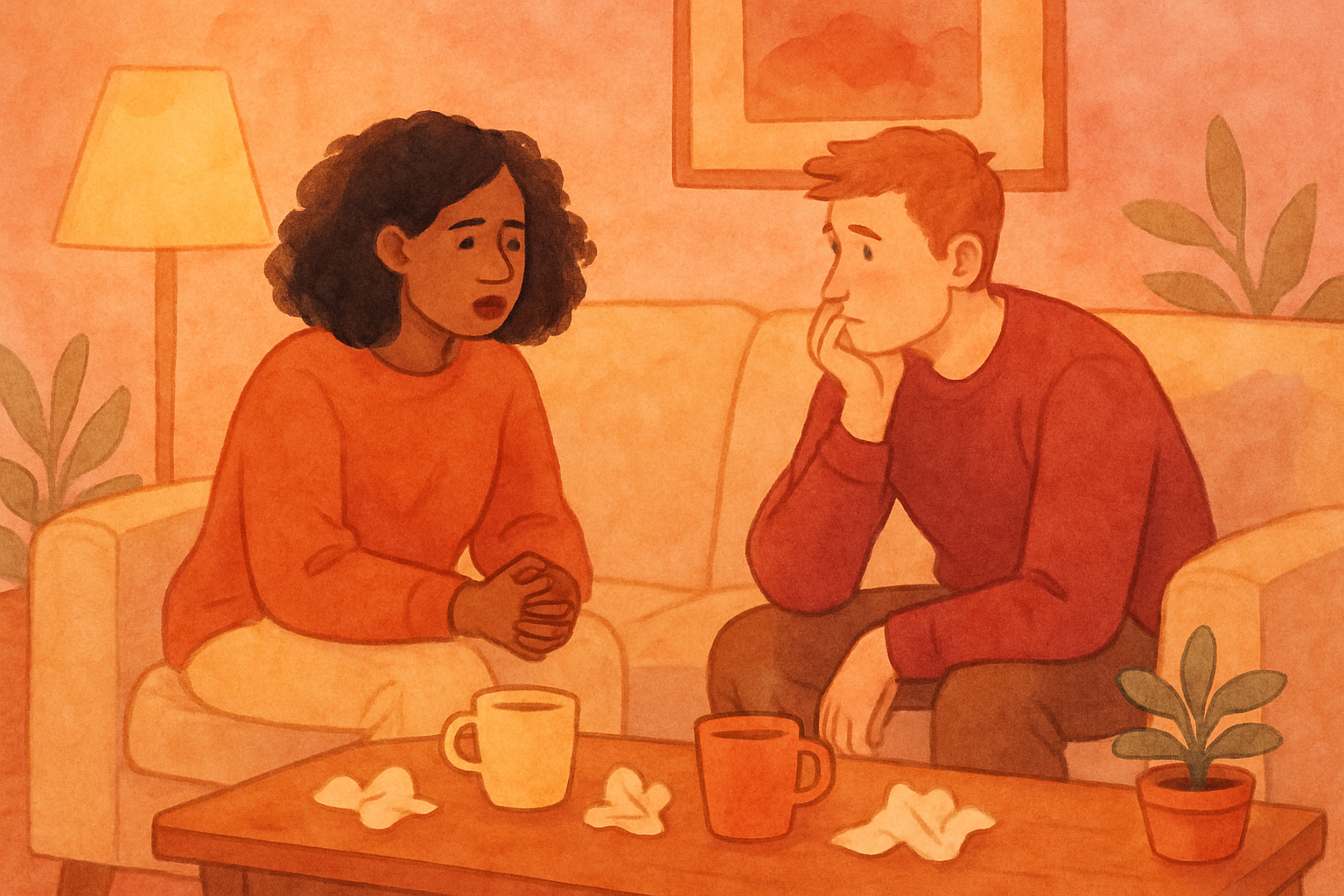
There's a specific kind of silence that follows a bad fight with someone you love. Not the comfortable, companionable quiet you share on a Sunday morning — but the heavy, crackling kind where you're both still in the same room and somehow miles apart.
Most of us have been there. And most of us were never taught what to do next.
The cultural script around conflict in relationships tends to be binary: either avoid it entirely (toxic positivity, anyone?) or "win" it. Neither actually helps. What the research tells us is that the couples who last aren't the ones who never fight — they're the ones who know how to repair. And repair, it turns out, is a learnable skill.
Why All Couples Fight — and Why That's Actually Okay
Let's start with a truth that might feel counterintuitive: conflict isn't a sign that you're incompatible. Dr. John Gottman's decades of research at the University of Washington found that 69% of relationship problems are perpetual — meaning they never fully get resolved. They exist because two distinct people with different histories, needs, and nervous systems are trying to build a shared life. That's not a bug; it's a feature of intimacy.
The question isn't whether you fight. It's what you do in the hours and days that follow.
Learning how to argue without fighting — meaning, how to disagree without demolishing each other — comes down to understanding what's actually happening in your body and brain when conflict escalates, and what couples who repair well do differently.
What's Actually Happening in Your Brain During a Fight
When a fight gets heated, you're not dealing with a communication problem. You're dealing with a biology problem first.
Your amygdala — the brain's threat-detection system — doesn't distinguish between a predator and a partner who just said something dismissive. It floods your system with cortisol and adrenaline, your heart rate spikes, and suddenly you're operating from your most reactive self rather than your most thoughtful one. Gottman calls this "flooding," and it's one of the biggest predictors of relationship dissatisfaction.
Here's what matters: you literally cannot problem-solve, empathize, or repair when you're flooded. Your prefrontal cortex — the part responsible for rational thinking and perspective-taking — goes partially offline. This is why things escalate so fast and why apologies issued in the heat of the moment rarely land.
Understanding this isn't about letting yourself off the hook. It's about knowing that the fight itself might not be the right place to resolve anything.
## The 20-Minute Rule Nobody Told You About
One of the most evidence-backed techniques for managing conflict — and for learning how to argue without fighting — is the strategic pause. Not stonewalling. Not giving someone the silent treatment. An agreed-upon break, taken before the conversation derails.
Research suggests it takes approximately 20-30 minutes for the nervous system to fully return to baseline after being flooded. During that window, the brain needs something genuinely distracting — not rumination about the fight itself.
What this looks like in practice:
- Agreeing in advance on a signal (a word, a gesture) that means "I need 20 minutes, not that I'm done with this conversation."
- Actually separating — going for a walk, doing something with your hands, putting on music.
- Returning to the topic after the physiological reset, not mid-flood.
This sounds almost embarrassingly simple. And yet most couples either barrel through when they're dysregulated or shut down entirely — neither of which leads anywhere good.
## Signs You Are Compatible Enough to Repair
Here's something worth saying out loud: relationship compatibility doesn't mean you never conflict. It means you have — or are willing to develop — enough shared values and emotional investment to move through conflict together.
So what do signs you are compatible with someone actually look like after a fight?
- You both want to repair. This sounds obvious, but it's not. In relationships where one person is ready to reconnect and the other is still weaponizing silence, the repair cycle breaks down. Mutual willingness is foundational.
- You're curious about what the fight was really about. Most surface fights (who left the dishes, who forgot to text back) are actually about something deeper — feeling unseen, feeling like a low priority, fear of abandonment or engulfment. Compatible couples get interested in the root, not just the symptom.
- You can hold some humor alongside the tension. Gottman's research identifies repair attempts that include humor as particularly effective. This doesn't mean joking away real pain — it means that enough warmth exists in the relationship to crack a small smile even when things are hard.
If you're early in a relationship and wondering how to read these signals, it might be worth exploring a compatibility test for couples — not to get a verdict, but to open the conversations that surface what matters most.
How Attachment Styles Shape the Aftermath of a Fight
Your attachment style in dating and relationships doesn't just show up when things are good — it shows up loudly when things go sideways.
Anxious attachers tend to pursue connection after conflict. They want to resolve it now, may interpret distance as abandonment, and can escalate in an attempt to get reassurance. Their underlying fear: "This fight means you're leaving."
Avoidant attachers tend to withdraw after conflict. They need space to regulate, can read reconnection attempts as pressure, and may shut down emotionally. Their underlying fear: "This fight means I'm being controlled or suffocated."
Disorganized attachers often experience both drives simultaneously — wanting closeness and fearing it — which can make post-fight behavior hard to predict.
When an anxious and an avoidant are in the same relationship (a very common pairing, by the way), the aftermath of a fight can look like one person chasing the other down the hallway while the other retreats further. Neither is wrong. Both are scared. Understanding this dynamic doesn't fix it automatically, but it creates just enough space to stop taking each other's coping mechanisms personally.
Getting to know your attachment style — and your partner's — is one of the most useful things you can do for long-distance repair, too. If you're navigating long distance relationship tips, the stakes around conflict are even higher when you can't physically be in the same room to reconnect. Understanding what each of you needs post-fight becomes essential communication infrastructure.
What Healthy Conflict in Relationships Actually Looks Like
Let's demystify healthy conflict in relationships, because it doesn't look like what most people imagine. It's not calm, measured, debate-club style disagreement (though wouldn't that be nice sometimes). It's messier than that.
Healthy conflict looks like:
- Raising the issue at all, rather than letting resentment calcify in silence
- Using "I" statements ("I felt dismissed when—") rather than "you always" or "you never" framings that immediately put someone on the defensive
- Acknowledging what the other person got right, even in the middle of disagreeing with them
- Repair attempts mid-argument — a touch on the arm, a small joke, a "hey, I hate that we're fighting" — which signal that the relationship is more important than winning the point
- Knowing your dealbreakers and your non-dealbreakers. Not every difference is a dealbreaker in a relationship. Sorting out which differences matter existentially versus which are just friction is important self-awareness work.
This is also where self-awareness in dating and long-term relating pays dividends. The more you understand your own triggers, your own patterns, and what you're actually fighting for (connection, respect, safety), the better you get at expressing them rather than just reacting from them.
The Repair Conversation: What to Actually Say
Once you've both regulated, the repair conversation is where the real work happens. This isn't the same conversation as the original fight — it's a meta-conversation about the fight itself.
Some things that actually help:
"What did you need from me that you didn't get?" This question — asked with genuine curiosity rather than defensiveness — is one of the most disarming things you can say. It shifts the frame from "what did you do wrong" to "what does the relationship need."
"Here's my part in this." Real accountability doesn't come with a "but." "I'm sorry I got so loud, but you started it" is not a repair. A repair owns a specific behavior without immediately deflecting.
"Can you help me understand where you were coming from?" This is vulnerability in relationships in action. It asks you to be genuinely open to a perspective that made you want to shut down.
"What would help you feel closer to me right now?" For some people, it's a hug. For others, it's hearing a clear plan for how the behavior changes. Knowing someone's love language matters here — words of affirmation land differently than acts of service when it comes to feeling repaired.
This is also a great moment for questions to ask your partner that you might not think of on your own. If the organic conversation runs dry or gets circular, structured prompts can help you get underneath the surface argument. Pairloom's question-based games were built for exactly this — not just for fun date nights, but for helping couples have the conversations that actually matter, in a format that feels less like a deposition and more like a game.
Rebuilding Trust After the Fight
Trust in a relationship isn't built in grand gestures. It's built in the accumulation of small moments where someone showed up for you — and where you showed up for them. A repair conversation, handled with care, is one of those moments.
What actually rebuilds trust post-conflict:
- Following through on whatever was agreed during the repair conversation
- Not bringing the fight up as ammunition in future arguments
- Checking in in the days that follow — a text that says "I'm still thinking about our conversation. How are you doing?"
- Creating rituals of reconnection — a consistent date night, even a low-key one at home, signals that the relationship gets dedicated attention regardless of whatever static exists in the background
On the topic of date nights: you don't need a reservation or a plan. Some of the best reconnection happens over date night ideas at home — cooking together, playing a game that opens up real conversation, or just sitting on the floor with takeout and talking without screens. The point isn't the activity. The point is the signal: I'm choosing us right now.
When Fighting Becomes a Red Flag
There's a difference between relationship red flags vs differences worth sitting with. Recurring conflict about how to spend a Saturday is a difference. Recurring conflict where one person feels consistently unsafe, dismissed, or demeaned is a red flag.
Patterns that go beyond "we're still learning to fight well" include:
- Contempt (eye-rolling, mockery, name-calling) — Gottman identifies this as the single strongest predictor of relationship breakdown
- Stonewalling that goes on for days without any attempt to repair
- One partner consistently avoiding all conflict while the other carries all the relational labor
- Either person feeling afraid of the other's reactions
Recognizing the difference between rough edges that can be sanded down and patterns that are genuinely harmful is part of the ongoing work of self-awareness in dating and staying in relationships that are actually good for you.
The Long Game
The science of repair is, at its core, the science of choosing the relationship over and over — not perfectly, not without friction, but with enough intention to keep showing up.
Fighting well isn't about eliminating conflict. It's about building the kind of trust where you both know that even when things get hard, neither of you is going anywhere without a conversation first. That security is what lets couples take risks, be vulnerable, and grow — together rather than despite each other.
And it starts with what you do in the quiet after the storm.
Stop Wondering. Start Playing.
Pairloom turns the conversations that matter into games you'll actually enjoy. Invite your partner and discover how you really connect — in minutes, not months.
Stop wondering. Start playing.
Pairloom turns the conversations that matter into games you'll actually enjoy. Invite your partner and discover how you really connect — in minutes, not months.