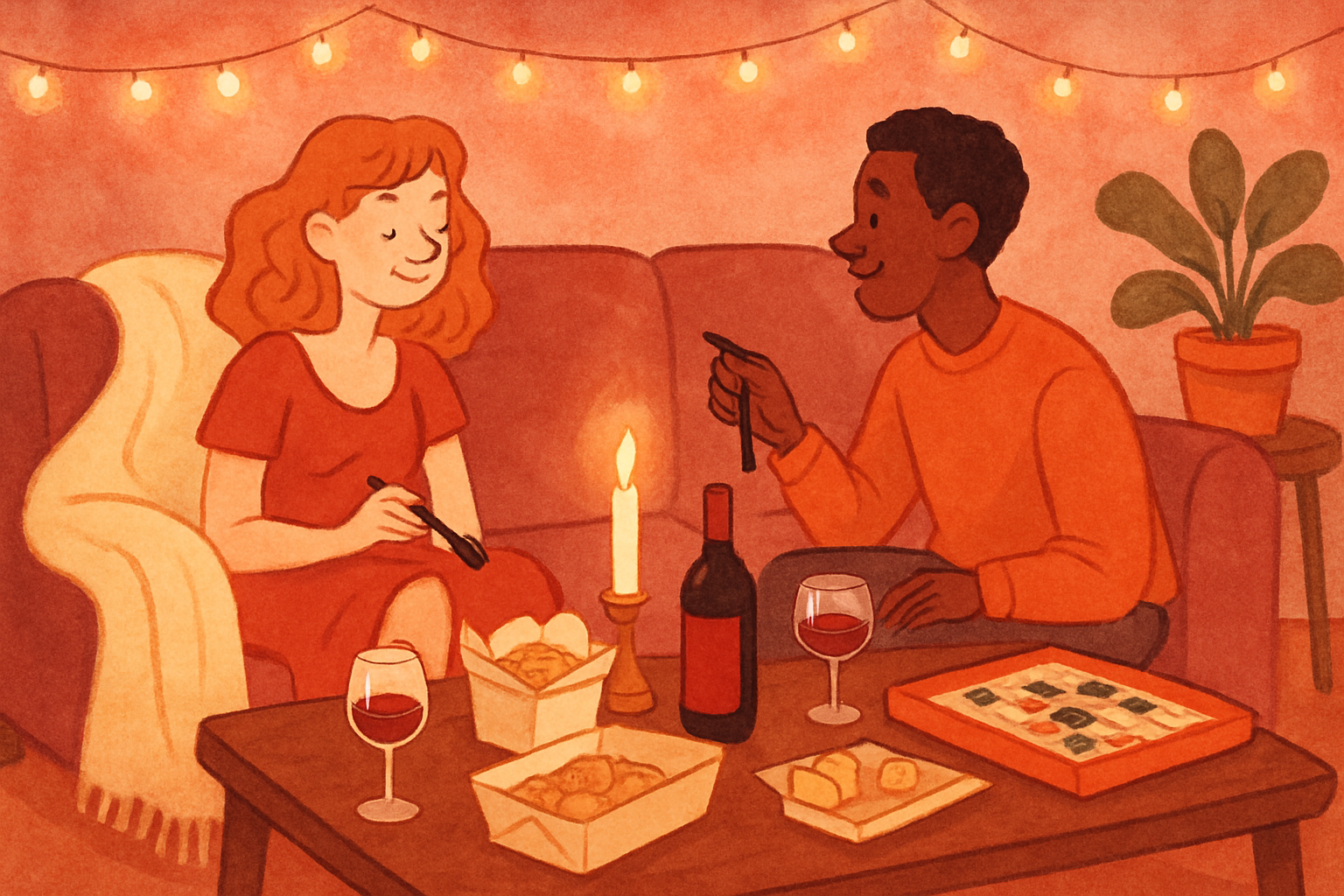
You've dimmed the lights, ordered takeout, and queued up another series on Netflix. Sound familiar? If your stay-at-home dates have fallen into the comfortable-but-predictable routine of couch surfing, you're not alone. But what if I told you that some of the most revealing and connection-building dates happen without leaving your living room?
Research from the Journal of Social and Personal Relationships shows that couples who engage in shared creative activities report higher relationship satisfaction than those who stick to passive entertainment. The key isn't the activity itself—it's the collaborative discovery that happens when you create something together rather than just consuming it.
Let's reframe the stay-at-home date: it's not a compromise because you can't go out, it's an opportunity to see each other in a completely new light.
Why does creating together beat Netflix and chill?
Before we dive into specific ideas, let's talk about why shared creation is relationship gold. When you're passively watching a movie, you're both focused on the same external stimulus. Your brains are in consumption mode, not connection mode.
But when you're building, cooking, or playing together, you're forced to communicate, negotiate, problem-solve, and reveal parts of your personality that don't come out during everyday conversations. You see how your partner handles frustration when the recipe goes wrong, how they celebrate small wins, and how they think through problems.
Dr. Arthur Aron's research on self-expansion in relationships found that couples who regularly engage in novel, challenging activities together maintain higher levels of relationship satisfaction over time. The activities that had the biggest impact? Those requiring collaboration and creativity.
How do you turn an activity into connection?
The magic isn't in the activity—it's in how you approach it. Here are the elements that transform any home date from "something to do" into "something that brings us closer":
Remove the pressure to be perfect. The goal isn't to create a masterpiece or nail the recipe. It's to learn something new about each other. Embrace the mess, laugh at the failures, and celebrate the weird results.
Pay attention to the process, not just the outcome. Notice how your partner approaches the task. Are they methodical planners or spontaneous experimenters? Do they read all the instructions first or dive right in? These insights tell you volumes about how they navigate life.
Build in reflection moments. After each activity, spend a few minutes talking about what surprised you, what you learned, or what you want to try differently next time. This turns the experience into a conversation starter rather than just a fun memory.
What are the most connection-building creative dates?
Portrait partners
Set up easels (or just use paper and clipboards) and paint or draw each other. This isn't about artistic skill—it's about really looking at each other. When was the last time you spent 30 uninterrupted minutes studying your partner's face?
What it reveals: How you see each other, literally and figuratively. Do you focus on the details or capture the overall impression? How do you handle the vulnerability of being both artist and subject?
Level it up: Take turns posing in different "moods" or characters. Paint each other as superheroes, historical figures, or in the style of your favorite artist.
Build something together
Pick a project you can complete in one evening: a puzzle, LEGO set, piece of furniture from that Swedish store, or even a blanket fort. The key is choosing something that requires collaboration.
What it reveals: Your communication styles under mild pressure. Who takes charge? Who pays attention to details? How do you handle disagreements about the "right" way to do something?
Level it up: Give yourselves a time limit or constraint, like building the tallest tower with household items or creating something using only materials you can find in one room.
Memory lane mapping
Create a visual timeline of your relationship using photos, ticket stubs, or even just drawings on a big sheet of paper. Include moments both big (first "I love you") and small (that weird inside joke from month two).
What it reveals: Which moments stood out to each of you and why. You might discover that what felt like a throwaway Tuesday to you was actually a pivotal moment for your partner.
Level it up: Create separate timelines first, then compare them. What did you each remember differently? What did one of you forget that was important to the other?
Which culinary adventures actually work?
Mystery ingredient challenge
Each person secretly chooses three random ingredients from your kitchen. Then you have to create a meal together using all six ingredients. No cheating with online recipes—this is pure collaboration and creativity.
What it reveals: How you handle uncertainty and work together under constraints. Do you build on each other's ideas or stick stubbornly to your vision? How do you react when things don't go according to plan?
Level it up: Add themes like "comfort food" or "fancy restaurant" to guide your creativity. Or make it a friendly competition where you each create a dish and vote on the winner.
Restaurant recreation
Choose a restaurant you both love and try to recreate an entire meal at home. Research the techniques, shop for special ingredients, set the table with candles and cloth napkins—the whole experience.
What it reveals: Your teamwork in the kitchen and attention to detail. Who's the natural chef and who's the sous chef? How do you divide tasks and support each other?
Level it up: Dress up as if you're going to the actual restaurant. Create a "wine" pairing (even if it's just different types of sparkling water). Write a review of your recreation attempt.
Childhood favorites tournament
Each person cooks a dish that reminds them of childhood—maybe it's your mom's spaghetti or that weird snack combination you invented in fourth grade. Share the stories while you cook and eat.
What it reveals: The comfort foods and family traditions that shaped you. Food is deeply tied to memory and identity, so this often leads to stories you've never shared before.
Level it up: Rate each other's childhood favorites and explain your scores. Bonus points if you call family members to get the "real" recipe and hear embarrassing stories about your childhood cooking attempts.
What games actually bring you closer?
Board games with a twist
Pick games that require communication and teamwork rather than direct competition. Cooperative games where you win or lose together tend to be better for bonding than games where you're trying to destroy each other.
What it reveals: How you strategize, communicate under pressure, and handle both victory and defeat as a team.
Level it up: Create your own rules variations or combine elements from different games. The act of negotiating new rules together is often more fun than the actual game.
Truth or dare, grown-up edition
Move beyond middle school questions to prompts that actually reveal something meaningful. "What's a risk you want to take in the next year?" or "Describe a moment when you felt most proud of yourself."
What it reveals: Deeper layers of your personalities, dreams, and perspectives that don't come up in daily conversation.
Level it up: Write prompts on slips of paper ahead of time, including some silly ones mixed with meaningful ones. Or create themed rounds like "childhood memories," "future dreams," or "silly hypotheticals."
Pairloom games
Speaking of games designed to deepen connection, this is where tools like Pairloom shine. Unlike generic board games, Pairloom creates personalized experiences based on your relationship dynamics, serving up conversation starters and challenges that are actually relevant to your situation.
What it reveals: The platform's games are specifically designed to surface insights about communication patterns, shared values, and relationship strengths you might not have noticed.
Level it up: Use Pairloom's insights as jumping-off points for deeper conversations. If a game reveals that you both value adventure but define it differently, spend time exploring what adventure means to each of you.
How do you tap into nostalgia for connection?
Photo archaeology
Dig through old photos on your phones, computers, or (if you're vintage) physical albums. Take turns showing each other pictures from before you met, explaining the context and stories behind them.
What it reveals: The experiences, relationships, and moments that shaped who you are today. You'll see each other through the lens of your past selves.
Level it up: Create a shared digital album of your favorite discoveries, or print out some photos and create a mini-scrapbook of your pre-relationship lives.
First date recreation
Try to recreate your first date at home. If you met at a coffee shop, brew fancy coffee and sit at your kitchen counter. If it was dinner and a movie, cook similar food and watch the same type of film.
What it reveals: How you've both changed since you first met and what initially drew you to each other. It often brings back the excitement and nervousness of early dating.
Level it up: Dress like you did on your first date (or how you wish you had dressed). Try to remember specific conversations you had and see how your perspectives have evolved.
Time capsule creation
Gather items that represent your relationship right now—photos, ticket stubs, a playlist, written predictions about your future, answers to questions about your current hopes and dreams.
What it reveals: How you see your relationship in this moment and what you hope for in the future. It's also a gift to your future selves.
Level it up: Set a specific date to open it (six months, one year, five years) and make opening it another special date night tradition.
Which sensory experiments create the deepest connection?
Blindfolded taste adventure
One person is blindfolded while the other feeds them different foods, textures, and flavors. The goal isn't to guess what each item is, but to really experience and describe the sensations.
What it reveals: How you communicate about subjective experiences and how comfortable you are with vulnerability and trust.
Level it up: Include foods from each other's cultural backgrounds or childhood favorites. The person feeding gets to share stories about each item while the other experiences it blind.
Musical memory exchange
Create playlists for each other, but with a twist: each song should remind you of a specific moment, person, or feeling. Take turns playing songs and explaining the memories or emotions attached.
What it reveals: The soundtrack to your inner life and emotional landscape. Music is deeply personal, so this often leads to stories and feelings you've never shared.
Level it up: Create collaborative playlists for different moods or future experiences you want to have together. Or challenge each other to find songs that capture specific, hard-to-describe feelings.
Texture exploration
Gather items with interesting textures from around your house—velvet, sandpaper, smooth stones, fuzzy blankets. With eyes closed, take turns experiencing different textures and describing not just how they feel, but what emotions or memories they evoke.
What it reveals: How you process sensory experiences and the unexpected connections between physical sensations and emotions or memories.
Level it up: Create a "texture story" together where you take turns adding to a narrative based on the feelings each texture inspires.
How do you make it more than just an activity?
The difference between a fun evening and a connection-building date comes down to intention and attention. Here's how to make sure your stay-at-home dates actually strengthen your bond:
Start with curiosity, not expectations. Approach each activity wondering what you'll discover about your partner, not assuming you already know how they'll react.
Notice the small moments. Pay attention to how your partner's face lights up when they figure something out, how they handle frustration, or what makes them laugh unexpectedly.
Ask follow-up questions. If something surprises you about how your partner approaches the activity, dig deeper. "I noticed you read all the instructions before starting—do you always prefer to have a plan?" can lead to fascinating conversations about how you each navigate uncertainty.
Share your internal experience. Don't just focus on the activity—talk about what's going through your mind. "I'm feeling competitive right now and I don't know why" or "This reminds me of helping my dad build things when I was little" turns the activity into a window into your inner world.
Build traditions. If something works well, make it a regular thing. Maybe Sunday mornings become cooking experiment time, or Friday nights are for trying new creative projects. Having regular rituals to look forward to strengthens your sense of "us."
Stop wondering. Start playing.
Pairloom turns the conversations that matter into games you'll actually enjoy. Invite your partner and discover how you really connect — in minutes, not months.
Stop wondering. Start playing.
Pairloom turns the conversations that matter into games you'll actually enjoy. Invite your partner and discover how you really connect — in minutes, not months.