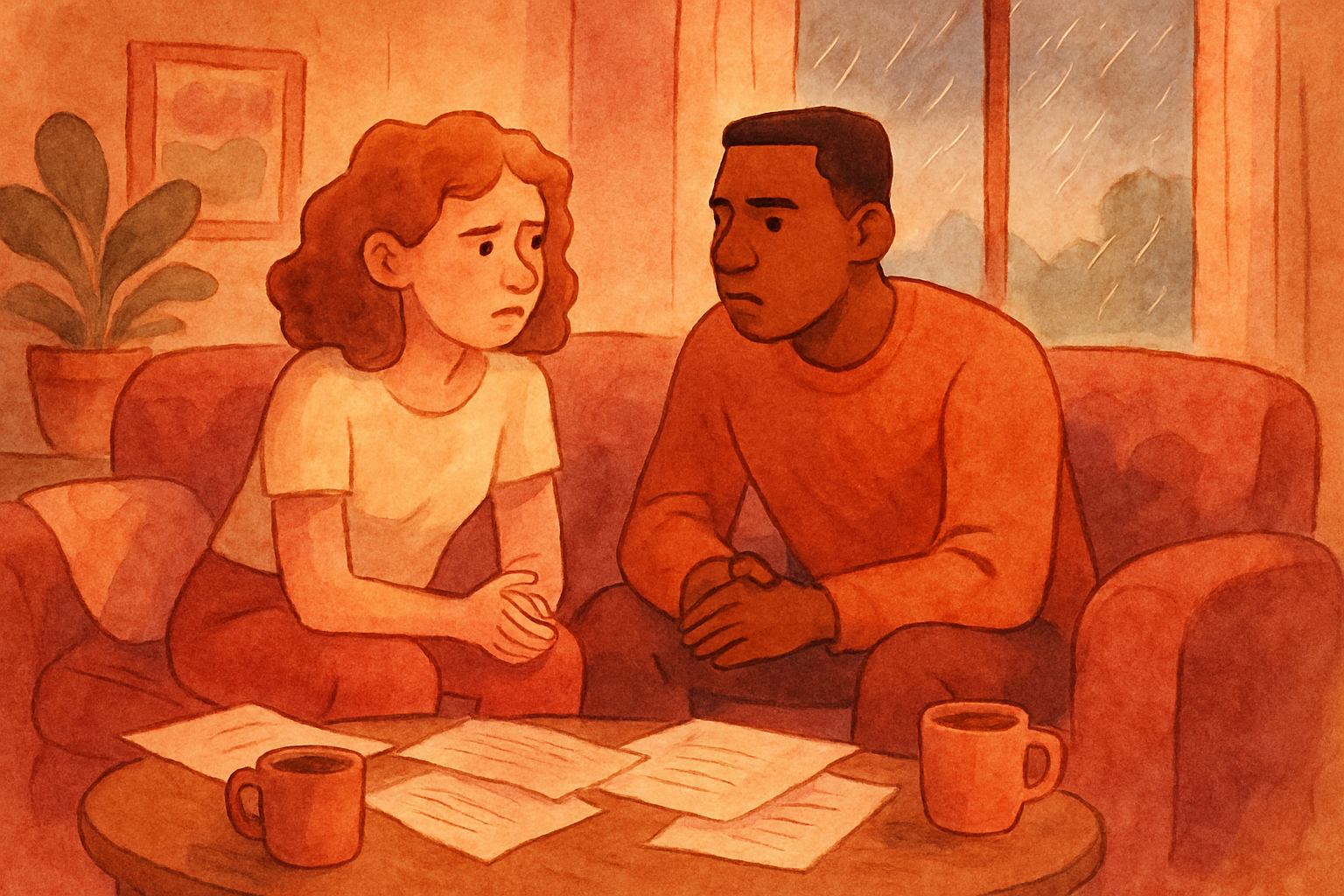
One of the most revealing moments in any relationship isn't a romantic dinner or a weekend getaway — it's the Tuesday afternoon when everything falls apart at once. The job falls through. The car breaks down. Someone's parent gets sick. Suddenly, you're not two people on a date putting your best foot forward. You're two human beings under pressure, and pressure has a way of showing you exactly who you're dealing with.
If you've ever wondered whether you and your partner are truly built for the long haul, the answer probably isn't hiding in the good times. It's hiding in the hard ones.
Why Stress Is Actually a Compatibility Test in Disguise
Researchers who study long-term relationships have found something counterintuitive: couples who never fight, never face hardship together, and never navigate real tension often struggle more when life inevitably delivers a curveball. The reason? They haven't built what psychologists call "relationship resilience" — the shared capacity to weather difficulty without fracturing.
Dr. John Gottman's decades of research at the University of Washington identified that it's not the presence of conflict that predicts relationship failure. It's the way couples handle it. Specifically, the ratio of positive to negative interactions during stress (his famous "5:1 ratio") matters far more than whether couples argue at all.
In other words, signs you are compatible aren't just visible in how much you enjoy each other — they're most visible in how you treat each other when enjoyment is the last thing on your mind.
What "Stress" Actually Reveals About Compatibility
Stress doesn't create character flaws. It reveals them. But it also reveals strengths — empathy, patience, creativity, commitment — that can stay hidden during easier seasons.
Here's what to pay attention to when the pressure is on:
Do you regulate each other, or dysregulate each other?
Co-regulation is one of the most underappreciated relationship phenomena. It's the idea that humans are wired to calm each other down — through tone of voice, physical touch, presence, and attunement. Securely attached partners tend to do this naturally. When one person is stressed, the other becomes a kind of nervous system anchor.
If you've ever noticed that being around your partner during a hard week makes you feel less anxious — not because they solved your problem, but just because they were there — that's co-regulation at work. And it's one of the quieter signs you are compatible in a deep, biological sense.
On the flip side, if stress in one partner reliably triggers reactivity, withdrawal, or escalation in the other, that's worth paying attention to. It doesn't mean the relationship is doomed, but it does mean there's work to do around attachment styles in dating — specifically, how anxious or avoidant patterns tend to flare under pressure.
How do you make decisions when neither option is great?
Compatibility under stress shows up sharply in joint decision-making. When both options on the table involve some kind of loss — you can't afford the trip and still fix the roof — you get a front-row seat to your partner's values, communication patterns, and risk tolerance.
Do they make unilateral decisions and present them as fait accompli? Do they shut down and refuse to engage? Do they catastrophize? Or do they stay curious, keep you in the loop, and make space for your perspective even when they're scared?
How to communicate better in a relationship during high-stakes decisions often comes down to one deceptively simple skill: staying curious about your partner's inner world instead of treating them as an obstacle to your preferred outcome. Couples who can do this under stress are demonstrating something real.
What happens to physical and emotional affection?
Some people, when stressed, pour affection into their partner. Others withdraw. Neither is inherently "wrong," but mismatched stress responses around closeness can create a painful cycle: one partner reaches out for connection just as the other retreats into a shell — and both feel abandoned.
This is often where love languages become genuinely important rather than just an icebreaker question. If your primary love language is physical touch and your partner's stress response is to go cold and quiet, that gap needs a bridge — and the bridge is conversation, not assumption.
The "Healthy Conflict" Distinction Nobody Talks About Enough
There's a difference between conflict that damages a relationship and healthy conflict in relationships — the kind that actually strengthens the bond over time. Knowing the difference is one of the most valuable tools any couple can have.
Healthy conflict has a few hallmarks:
- It's about the issue, not the person. "I felt unheard when that decision was made without me" vs. "You never consider my feelings."
- It stays roughly in the present. Relitigating arguments from three years ago during a current dispute is a sign that something hasn't been processed or forgiven.
- Both people still fundamentally want resolution. Even when it's heated, there's an underlying orientation toward each other rather than away from each other.
- There's repair afterward. The argument doesn't define the relationship. Some form of reconnection follows.
Learning how to argue without fighting — in the sense of raising hard topics without contempt, stonewalling, or defensiveness — is actually a learnable skill. Couples who invest in this skill are building something durable.
What's interesting is that stress often accelerates this learning. Couples who have been forced to navigate something genuinely hard together sometimes emerge closer than couples who've floated through years of ease. The shared experience of "we got through that" becomes part of the relational identity.
Red Flags vs. Real Differences: A Critical Distinction
Not everything that comes up under stress is a relationship red flag. Sometimes what stress reveals is simply a difference — in communication style, in coping mechanisms, in how much alone time someone needs to recharge.
The difference between a dealbreaker and a difference worth working with often comes down to a few questions:
- Is this pattern consistent, or did it emerge specifically under extreme circumstances?
- Is your partner aware of the behavior and willing to reflect on it?
- Does it involve the erosion of trust, respect, or safety — or is it more about mismatched styles?
Dealbreakers in a relationship tend to involve things that compromise your fundamental sense of safety or respect: consistent lying, refusal to take any accountability, contempt that shows up regularly, or patterns that leave you feeling chronically unseen. Differences worth navigating tend to be more about logistics, preferences, and communication styles that can be bridged with enough goodwill and self-awareness.
Relationship red flags vs differences is one of the more nuanced distinctions in dating and partnership — and stress is one of the environments where it becomes clearest. Someone who snaps when they're scared but comes back with genuine remorse and repairs the rupture is showing you something different from someone who snaps and then acts like nothing happened.
If you're trying to sort through what you're actually seeing in your relationship, it can help enormously to explore this explicitly — not in the middle of a conflict, but in a calmer moment. One of the best things Pairloom does here is create a low-stakes environment for exactly that kind of exploration. Prompts and games designed to uncover how each of you thinks about trust, conflict, and repair can surface information that years of surface-level dating never would. You can check out more on how conversations reveal compatibility over on our blog.
The Role of Self-Awareness in Dating (and Partnering)
Here's an uncomfortable truth: sometimes the "compatibility problem" under stress isn't your partner — it's the version of yourself that shows up when things get hard.
Self-awareness in dating — and in long-term relationships — means being willing to ask the question, "What am I contributing to this dynamic?" not as self-blame, but as genuine curiosity. Do you become critical when you're anxious? Do you go quiet and hope your partner telepathically notices? Do you make jokes to deflect from anything emotionally serious?
Understanding your own stress responses is, arguably, the single most valuable thing you can bring to a relationship. It allows you to communicate needs instead of just expressing them through behavior that your partner has to decode. "I tend to get quiet when I'm overwhelmed, and it's not about you — it just means I need about an hour before I can talk" is so much more useful than just going quiet and letting your partner spiral trying to figure out what they did wrong.
Vulnerability in relationships — the real kind, not the performative kind — is what makes this level of self-disclosure possible. And vulnerability, paradoxically, tends to be easiest in contexts that feel safe and even playful. Serious sit-down conversations with high stakes can trigger defensiveness. A game, a shared activity, or a well-designed prompt can open the same door with far less friction.
Questions Worth Asking Before (and During) Hard Times
If you want to understand how compatible you really are, don't wait for the crisis. Build the foundation now. Here are some questions to ask your partner that get at stress compatibility specifically:
- "When you're overwhelmed, do you need space or closeness? Has that always been true for you?"
- "What's the hardest thing you've ever navigated, and what did you learn about yourself from it?"
- "How did conflict get handled in your family growing up? How do you feel about that now?"
- "What would it look like to you if I was really showing up for you during a hard time?"
- "Is there anything you tend to do when you're stressed that you think I might misinterpret?"
These aren't light questions — but they don't have to be heavy either. The goal isn't a therapy session; it's genuine getting to know your partner at a level that goes beyond surface preferences and shared interests. For couples who want a gentler on-ramp to this kind of depth, Pairloom's couples games to play together are designed exactly for that: to surface meaningful conversation through connection rather than confrontation.
What Long-Lasting Couples Actually Do Differently
The research on what makes couples last consistently points to a cluster of behaviors that look almost unremarkable in isolation but add up to something significant: they assume positive intent more often than not, they repair conflict quickly rather than letting resentment calcify, they maintain some form of regular, genuine connection (not just coexisting), and they know each other's inner worlds well enough to be surprised occasionally — in a good way.
Trust in a relationship isn't built in dramatic moments of loyalty. It's built in the accumulation of small moments where one partner reaches out and the other reaches back. Under stress, those moments become harder to generate — which is exactly why they matter more.
The couples who emerge from hard seasons closer than before aren't the ones who were lucky enough to have compatible personalities from day one. They're the ones who treated compatibility as something to actively build, not just passively discover.
That's the real stress test. Not whether life gets hard — it will — but whether you've built enough of a foundation that when it does, you face it together.
If you're in the early stages of a relationship and want to build that foundation before the hard moments arrive, or if you're an established couple who wants to know each other more deeply than daily life usually allows, Pairloom's relationship discovery games are a genuinely fun place to start. And if you're navigating the talking stage dating phase and wondering how to tell if something real is forming, the questions above are a good place to begin.
Stop Wondering. Start Playing.
Pairloom turns the conversations that matter into games you'll actually enjoy. Invite your partner and discover how you really connect — in minutes, not months.
Stop wondering. Start playing.
Pairloom turns the conversations that matter into games you'll actually enjoy. Invite your partner and discover how you really connect — in minutes, not months.