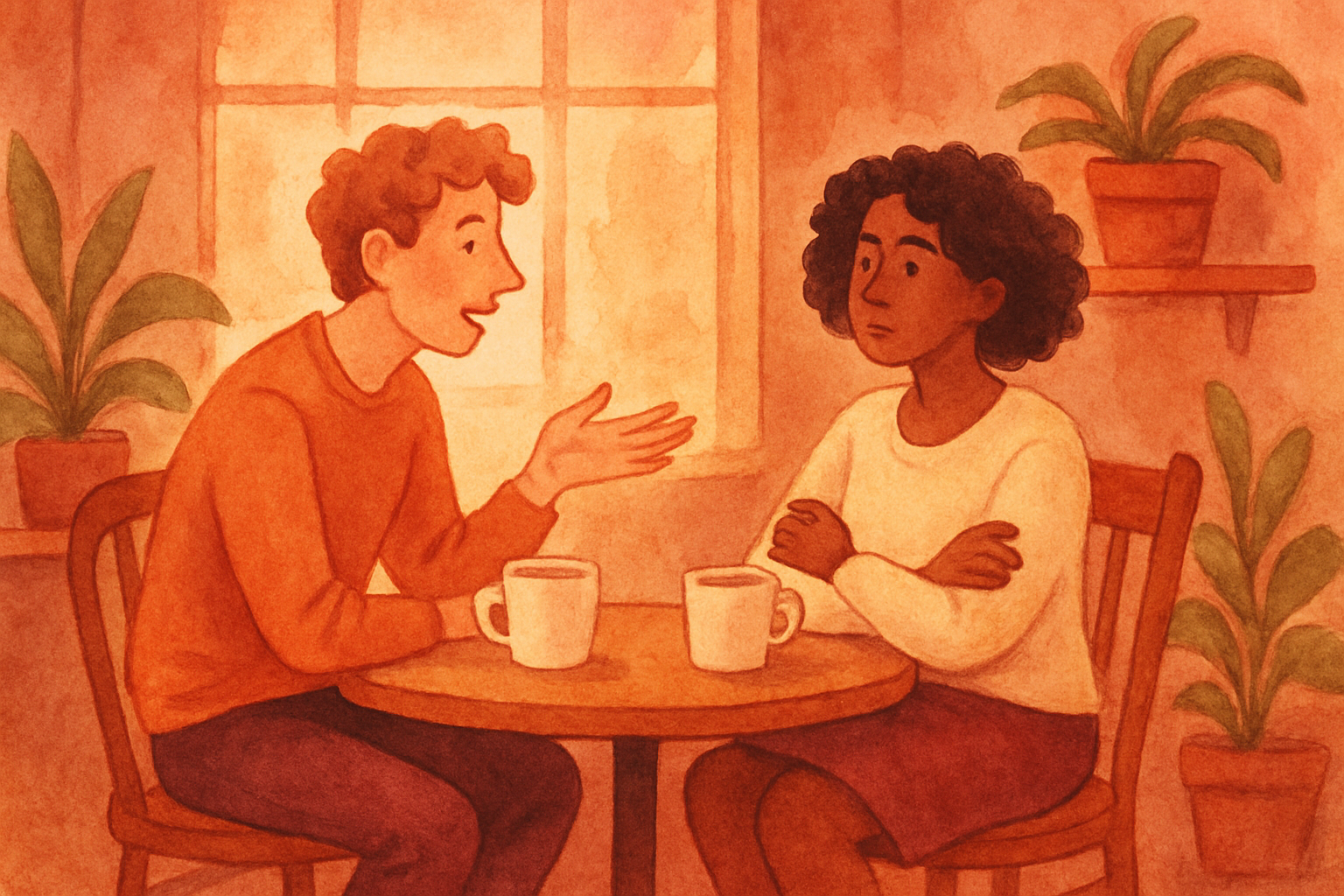
The talking stage has its own unofficial rulebook: text back, but not too fast. Show interest, but not too much. Be vulnerable, but only in the ways that seem cool and low-stakes. It's exhausting — and underneath all of it, your attachment style is quietly running the show.
If you've ever found yourself refreshing your messages after a slow reply, rehearsing texts in your notes app before sending them, or pulling back right when things start to feel real — that's not you being "too much" or "emotionally unavailable." That's your nervous system doing what it learned to do, often long before you were old enough to have a situationship.
Understanding attachment styles in dating doesn't mean you're about to self-diagnose yourself out of every relationship. It means you start to see your patterns clearly — and that clarity is actually the thing that changes everything.
What Even Is the Talking Stage, Exactly?
If you're in the 25-40 age range and dating in 2026, the talking stage is your life now. It's that undefined pre-relationship limbo where you're more than strangers but less than official — texting daily, maybe going on a few dates, figuring out if this person is worth the emotional investment.
It's also the stage where attachment patterns hit hardest. There's no commitment to cushion the anxiety, no label to provide security, and no established norms to lean on. Just two people trying to figure each other out while managing the slow-burn terror of being known.
Dating app fatigue is real, and many people arrive at the talking stage already depleted — having swiped and matched and ghosted and been ghosted so many times that their nervous systems are essentially pre-loaded for disappointment. When you layer attachment wounds onto that kind of exhaustion, you get some very predictable (and very human) chaos.
A Quick Primer on the Four Attachment Styles
Before we get into the talking stage specifically, here's a fast, non-clinical breakdown:
- Secure attachment: Generally comfortable with closeness and independence. Can communicate needs without catastrophizing.
- Anxious attachment: Craves closeness, highly attuned to shifts in a partner's behavior, prone to overthinking and reassurance-seeking.
- Avoidant attachment: Values independence strongly, tends to pull back when emotional intimacy increases, may read closeness as a threat to autonomy.
- Fearful-avoidant (disorganized): Wants intimacy but also fears it. Often experiences push-pull dynamics — leaning in, then retreating.
These styles aren't personality flaws. They're strategies your nervous system developed to get its needs met in earlier relationships, usually starting with caregivers. The tricky part is those strategies don't always serve you when you're a grown adult trying to figure out if someone is worth a second date.
## How Each Attachment Style Shows Up During the Talking Stage
The Anxious Attached Person
For someone with an anxious attachment style, the talking stage is an exercise in managing a near-constant low hum of uncertainty. They're deeply invested early — sometimes before they even fully know the person — and hyper-attuned to any signal that might indicate withdrawal.
You know this is you if you've ever:
- Spent twenty minutes analyzing whether "haha" versus "lol" means something different
- Noticed a slight delay in response time and started mentally preparing for the worst
- Felt the urge to bring up "what are we" way earlier than felt comfortable
- Done something to test whether the other person would pull away
The talking stage is particularly rough for anxious attachers because there are genuinely no rules. That ambiguity isn't neutral — it's a breeding ground for the anxious brain. The question "do they like me?" runs on a loop, and behaviors that look like neediness from the outside are really just nervous system cries for reassurance.
What helps: Recognizing that the urge to seek reassurance is valid, but acting on it impulsively often backfires. Learning to self-soothe and tolerate uncertainty — without suppressing your very real need for connection — is the work.
The Avoidant Person
Someone with an avoidant attachment style might actually love the talking stage at first. Things are light, there's no pressure, and they can engage on their own terms. But the moment things start feeling real — when the other person starts to matter — the avoidant nervous system starts looking for the exit.
This doesn't mean they don't care. It means caring feels genuinely threatening to them. Emotional closeness can trigger a kind of alarm system: this is too much, this is unsafe, I need space.
From the outside, this looks like:
- Suddenly pulling back after a really good date
- Getting vague or less communicative just when things were going well
- Nitpicking reasons why this person "isn't quite right"
- Prioritizing alone time intensely when the relationship starts to feel like it has stakes
Avoidant attachers often don't realize how their withdrawal lands. The anxious person on the other end experiences it as rejection and doubles down on pursuing — which then triggers more avoidant retreat. This is the infamous anxious-avoidant trap, and the talking stage is basically where it gets built.
The Fearful-Avoidant Person
This is possibly the most disorienting attachment style to live with, and the talking stage makes it feel like whiplash. A fearful-avoidant person both wants closeness and fears it at the same time. They might pursue intensely, then suddenly feel suffocated and back off — only to miss the person and come back.
From the inside, this feels genuinely confusing. From the outside, it can look like mixed signals or inconsistency. Neither of those is entirely accurate — it's a person whose nervous system is at war with itself over whether connection is safe.
The talking stage, with all its ambiguity, tends to amplify this inner conflict. There's no container yet for the relationship, so the push-pull plays out more visibly.
The Securely Attached Person
Here's the thing about secure people in the talking stage: they're usually not spending a lot of energy performing disinterest to seem cool. They communicate interest fairly directly, can tolerate slow replies without tailspinning, and tend to have a realistic sense of how things are going without over- or under-reading signals.
This doesn't mean they're boring or immune to nerves. It means their baseline is: I'm okay, and if this doesn't work out, I'll be okay then too. That kind of groundedness is — not surprisingly — deeply attractive. And it's a state any attachment style can learn to move toward, with enough self-awareness and practice.
The Role of Vulnerability in Relationships (And Why It's Terrifying During the Talking Stage)
Psychologist Brené Brown's research has long suggested that vulnerability in relationships is the birthplace of real connection — but it's also the thing most of us are quietly terrified of, especially before we know if the other person is "safe."
The talking stage is where vulnerability quietly tests itself. Do I tell them about the weird hobby? Do I admit I'm nervous? Do I share the thing that might make them think less of me?
Your attachment style shapes how you answer those questions. Anxious attachers might overshare early (vulnerability as a test — will you accept me?). Avoidants might reveal very little (vulnerability feels dangerous). Fearful-avoidants might oscillate between both. Secure attachers tend to disclose gradually and authentically, matching the pace of the developing connection.
Understanding this is useful not because you should perform a different attachment style, but because self-awareness in dating is what allows you to notice when you're acting from fear versus acting from genuine intention.
How to Communicate Better in a Relationship That Hasn't Technically Started Yet
One of the weirdest challenges of the talking stage is that you're supposed to be communicating well — showing your personality, demonstrating interest, being emotionally intelligent — while also not technically being in a relationship where those expectations are clearly established.
Some practical anchors that work regardless of attachment style:
Name what you notice, not what you assume. Instead of "you've been weird lately," try "I noticed I haven't heard from you much this week and I'm not sure how to read it." One is an accusation; the other opens a door.
Know your non-negotiables early. Understanding your own dealbreakers in a relationship — not anxiously scanning for relationship red flags vs differences in every small behavior, but genuinely knowing what you need — keeps you from auditioneering for someone who isn't a fit.
Ask real questions. The talking stage often stays surface-level because everyone's afraid to go deeper first. But the questions to ask your partner (or future partner) that actually matter — about family, conflict styles, what they want from life — are the ones that let you assess real relationship compatibility faster and with less guesswork.
If you're looking for a low-pressure way to have those conversations, Pairloom's question games are designed exactly for this phase — they're structured enough to spark depth, but playful enough that it doesn't feel like an interview.
Can You Actually Change Your Attachment Style?
The research here is genuinely encouraging. Attachment styles are not fixed personality traits — they're adaptive patterns that developed in response to your relational environment. That means they can shift, particularly through two things: earned security (developing a relationship with a securely attached person) and self-awareness over time.
You don't have to complete years of therapy before you're allowed to date. But knowing your patterns — really knowing them, not just intellectually categorizing yourself — makes you a more honest and connected partner from day one.
If you want to dig into this more, our post on how to communicate better in a relationship walks through some of the practical mechanics. And if you're trying to figure out where the talking stage ends and something real begins, our guide to navigating the situationship is worth a read too.
What the Talking Stage Is Really For
Here's a reframe: the talking stage isn't just a waiting room you have to survive before the relationship starts. It's actually one of the most information-rich phases of dating, if you know what to pay attention to.
Your attachment style is going to show up here. So is theirs. And the way two attachment styles interact in these early, unscripted moments tells you a lot about what the dynamic will look like once things get more serious.
- Are they curious about you, or are they performing?
- When you set a small boundary, do they respect it?
- Do they bring up the future in ways that feel grounded or rushed?
- How do you feel in the days after spending time with them — more settled or more anxious?
The signs you are compatible with someone aren't usually found in a compatibility test for couples (though those can be genuinely useful later). They're found in the accumulation of small moments — how conflicts get navigated, how repair happens after misunderstandings, how safe you feel being honest.
The talking stage is where those patterns start.
The Bottom Line
Your attachment style didn't show up to sabotage the talking stage. It showed up because it always shows up — it's the lens your nervous system uses to make sense of intimacy. The goal isn't to be a different person. It's to understand your patterns well enough that you can make choices that actually reflect who you are and what you want, instead of just reacting to old wiring.
That kind of self-awareness in dating is slow, non-linear work. But it's also the most genuinely useful thing you can bring to any connection — talking stage and beyond.
Stop wondering. Start playing.
Pairloom turns the conversations that matter into games you'll actually enjoy. Invite your match (or your partner) and discover how you really connect — in minutes, not months. Whether you're deep in the talking stage or navigating something more established, Pairloom meets you where you are.
Stop wondering. Start playing.
Pairloom turns the conversations that matter into games you'll actually enjoy. Invite your partner and discover how you really connect — in minutes, not months.