Why You Keep Dating the Same Person (And How to Break the Cycle)
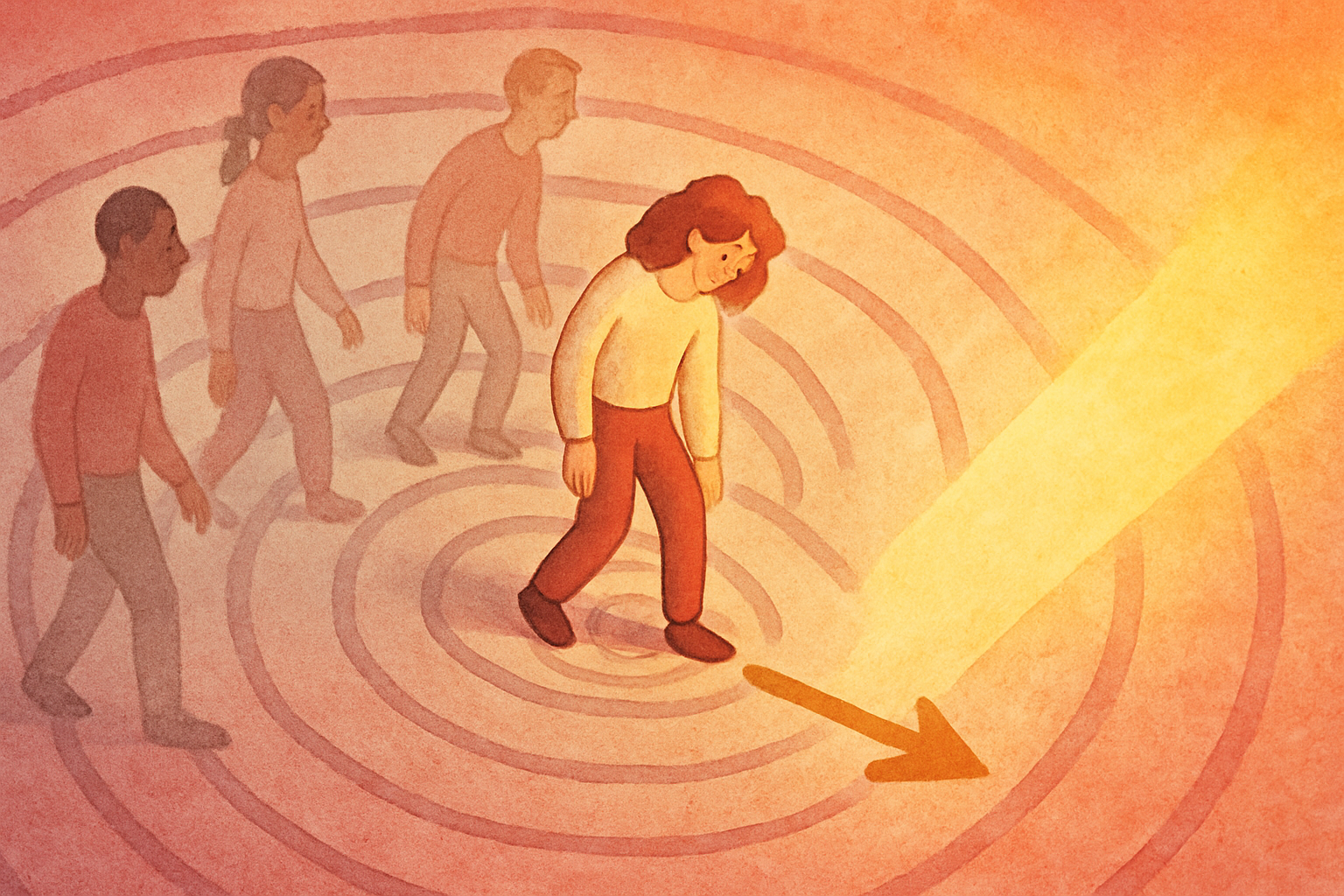
You know the feeling. You're three months into a new relationship, and suddenly it hits you: This has happened before. Not the person — your ex didn't have dimples or drive a Honda Civic. But the dance? The way you bend yourself into pretzels trying to earn their attention? The familiar sting when they pull away just as you're getting closer? The exhausting cycle of pursuing someone who seems perpetually one foot out the door?
Welcome to the maddening world of dating patterns. If you've ever wondered why your relationships feel like different actors performing the same play, you're not alone. Research shows that most of us unconsciously gravitate toward partners who trigger familiar emotional patterns — even when those patterns caused us pain in the past.
But here's the thing: recognizing your pattern is the first step to breaking free from it.
What exactly are dating patterns, and why do they feel so familiar?
Dating patterns aren't about consistently choosing tall, dark strangers or having a thing for musicians (though that's a pattern too). The patterns that really matter — the ones that keep us stuck — are about emotional dynamics and relational roles we unconsciously recreate.
Think of it this way: every relationship is essentially two people doing an intricate dance together. Some couples waltz smoothly in sync. Others do a chaotic tango full of dramatic dips and near-misses. The problem isn't the dance itself — it's when you find yourself doing the exact same dance with every partner, especially when it's not serving you.
Sigmund Freud called this phenomenon "repetition compulsion" — our unconscious drive to recreate situations that mirror unresolved conflicts from our past, particularly from childhood. Modern attachment theory has expanded on this concept, showing how our early relationships with caregivers create templates for how we expect love to feel and function.
"We don't just randomly fall for people," explains Dr. Amir Levine, author of Attached. "We're drawn to partners who fit our attachment style and activate familiar neural pathways — even if those pathways were formed during times of stress or neglect."
The result? That person who makes your heart race might be triggering excitement because they're recreating the uncertainty you felt as a child when your parent's attention was unpredictable. The "spark" you feel might actually be your nervous system recognizing a familiar pattern of hope and disappointment.
Why does your brain keep choosing the wrong dance partner?
Your brain isn't trying to sabotage your happiness — it's actually trying to protect you by sticking with what's familiar. From an evolutionary perspective, familiar equals safe, even when familiar includes some dysfunction.
Here's what happens neurologically: your brain processes new romantic interests through existing neural pathways carved by past experiences. When someone fits a familiar pattern, those pathways light up with recognition. Your brain essentially says, "Oh, I know this dance! I've been practicing it for years."
This explains why the "butterflies in your stomach" feeling isn't always a good sign. Sometimes those butterflies are actually your nervous system's response to uncertainty and inconsistency — the same feelings you might have experienced with an emotionally unavailable parent or during a turbulent childhood relationship.
Meanwhile, someone who would actually be good for you might feel "boring" or "too easy" because they don't activate those familiar stress responses your brain has come to associate with love and attraction.
Research by Dr. Helen Fisher shows that the brain systems involved in romantic attraction — dopamine-driven reward pathways — are the same ones involved in addiction. Just like a gambler gets hooked on the unpredictable payout of slot machines, we can become addicted to the intermittent reinforcement of hot-and-cold romantic partners.
What are the most common dating patterns that keep people stuck?
While every person's pattern is unique, certain dynamics show up repeatedly. Here are the most common ones:
The Rescuer and the Rescued One partner consistently plays the role of the "fixer" — attracted to people with obvious problems they believe they can solve. The other partner unconsciously seeks someone to take care of them. The rescuer gets to feel needed and valuable; the rescued gets to avoid full responsibility for their life. The pattern breaks down when the rescuer becomes exhausted or resentful, or when the rescued person starts to feel suffocated and rebels.
The Pursuer and the Distancer This is perhaps the most common pattern: one person consistently chases emotional intimacy while the other consistently backs away from it. The pursuer interprets the distancer's unavailability as a challenge to win them over. The distancer feels overwhelmed by the pursuer's intensity and pulls back further. It's a dance that can go on indefinitely, with both partners getting just enough intermittent reinforcement to stay hooked.
The Overachiever and the Underachiever One partner is highly driven, responsible, and achievement-oriented. The other is more laid-back, spontaneous, or struggling with direction. Initially, they balance each other out — the overachiever gets to relax, and the underachiever gets structure. Over time, the overachiever may become resentful of carrying the load, while the underachiever feels judged and inadequate.
The Anxious and the Avoidant Based on attachment styles, this pattern involves someone who craves closeness but fears abandonment (anxious) pairing with someone who values independence and feels trapped by too much intimacy (avoidant). The anxious partner's need for reassurance triggers the avoidant partner's need for space, which triggers more anxiety, creating an escalating cycle.
How can you identify your specific dating pattern?
The key to identifying your pattern is looking beyond surface-level preferences to examine the emotional dynamics of your relationships. Here's how:
Map Your Last Three Relationships Get out a piece of paper and write down your last three significant relationships. For each one, ask yourself:
- Who did the pursuing? Who pulled back?
- Who was more emotionally expressive? Who was more reserved?
- Who gave more? Who received more?
- How did conflicts typically play out?
- What role did you consistently play?
Look for Your Emotional "Type" Instead of thinking about physical attributes, consider the emotional qualities you're repeatedly drawn to:
- Are you attracted to "mysterious" people who are hard to read?
- Do you gravitate toward people who need "fixing" or "saving"?
- Are you drawn to highly successful people you admire but feel inferior to?
- Do you consistently choose people who are emotionally unavailable?
Examine Your Childhood Relationships Consider the emotional dynamics in your family of origin:
- Was love conditional on achievement or behavior?
- Did you have to compete for attention or affection?
- Were emotions freely expressed, or was there a lot of walking on eggshells?
- Did you feel responsible for taking care of others emotionally?
Often, our romantic patterns mirror these early relational templates.
Notice Your Breakup Patterns How do your relationships typically end? Do you usually get dumped for being "too much"? Do you find yourself losing interest once someone becomes too available? Do your relationships end in explosive fights or gradual distance? The ending often reveals the underlying dynamic.
How do you break free from destructive dating patterns?
Breaking a dating pattern requires both awareness and deliberate action. It's not enough to recognize the pattern — you have to actively work against your automatic impulses.
Practice "Against-Type" Dating Once you've identified your pattern, try consciously dating against it. If you typically go for the mysterious, emotionally unavailable type, try accepting a date with someone who's openly interested and emotionally expressive. If you usually rescue people, try dating someone who has their life together.
This will feel uncomfortable at first. The person might seem "boring" or like you don't have "chemistry." That's actually a good sign — it means you're breaking free from your addiction to unhealthy relationship dynamics.
Use Objective Compatibility Tools One of the biggest problems with dating patterns is that they bypass our rational thinking. We make decisions based on "gut feelings" that are actually just familiar neural pathways firing. Using structured approaches to evaluate compatibility can help you make better choices.
This might mean:
- Taking time to really get to know someone before becoming physically involved
- Using compatibility questionnaires or relationship assessments
- Having structured conversations about values, goals, and attachment styles
- Getting input from trusted friends who know your patterns
Work on Your Own Attachment Style If your dating patterns stem from insecure attachment (which most do), working on becoming more securely attached will naturally improve your partner selection. This might involve therapy, but it can also include:
- Practicing self-soothing techniques when you feel triggered
- Learning to communicate your needs directly instead of through dramatic dynamics
- Developing a stronger sense of self-worth that doesn't depend on romantic validation
- Building secure friendships that model healthy relationship dynamics
Challenge Your Beliefs About Love Many dating patterns are reinforced by unconscious beliefs about what love should feel like. Common problematic beliefs include:
- "If it's not passionate and intense, it's not real love"
- "I need to earn love through achievement or caretaking"
- "Relationships require sacrifice and struggle to be meaningful"
- "If someone likes me too much too quickly, something must be wrong with them"
Identifying and challenging these beliefs can help you become open to healthier relationship dynamics.
Why do healthy relationships sometimes feel "wrong" at first?
This is perhaps the most confusing part of breaking dating patterns. When you start dating more securely attached, emotionally available people, it can feel deeply uncomfortable. Your nervous system might interpret their consistency as "boring" and their emotional availability as "desperate."
This is normal. Your brain has been wired to associate love with uncertainty, drama, or emotional intensity. A relationship that feels stable and predictable doesn't trigger those familiar excitement pathways.
Dr. Stan Tatkin, author of Wired for Love, explains it this way: "What we call 'chemistry' is often just the activation of familiar neural patterns, including stress responses. True compatibility might actually feel calm and easy by comparison."
The key is to push through this discomfort and give healthier dynamics time to feel natural. This process can take months or even years, but gradually, your nervous system will start to associate safety and stability with love instead of anxiety and unpredictability.
How can you build better relationship awareness going forward?
Breaking dating patterns isn't just about choosing different people — it's about developing better self-awareness and relationship skills overall. Here are some strategies:
Regular Relationship Check-ins Whether you're single or coupled, regularly examine your relationship dynamics. Are you falling into old patterns? What triggers your automatic responses? How could you respond differently?
Practice Mindful Dating Instead of letting attraction and chemistry drive all your decisions, try approaching dating more mindfully. Notice what you're drawn to and why. Take time to evaluate compatibility beyond just "how they make you feel."
Develop Emotional Regulation Skills Many dating patterns are driven by our inability to manage difficult emotions. Learning to self-soothe, communicate needs directly, and stay present during conflict can prevent you from falling into old dynamics.
Build a Support Network Having secure, supportive relationships outside of dating can provide a healthy reference point for what functional relationships look like. These relationships can also provide perspective when you're tempted to fall back into old patterns.
Understanding your dating patterns is like having a roadmap to your unconscious mind. It shows you not just who you've been choosing, but why — and more importantly, how to choose differently. The goal isn't to eliminate all excitement and chemistry from your love life, but to find partners who can provide both passion and security, both growth and stability.
Breaking free from destructive dating patterns takes time and conscious effort, but it's absolutely possible. The key is combining self-awareness with practical tools that help you make better choices — and maybe most importantly, learning to trust that love doesn't have to hurt to be real.
Stop wondering. Start playing.
Pairloom turns the conversations that matter into games you'll actually enjoy. Instead of relying on gut feelings that might be biased by old patterns, discover how you really connect through structured compatibility insights. Invite your partner and find out what makes you tick together — in minutes, not months.
Stop wondering. Start playing.
Pairloom turns the conversations that matter into games you'll actually enjoy. Invite your partner and discover how you really connect — in minutes, not months.